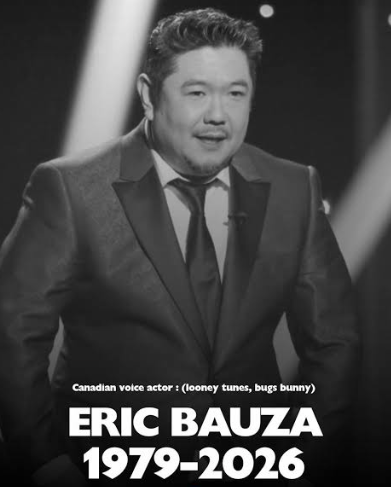
The animation world stands in sudden grief following the tragic passing of Eric Bauza, the three-time Emmy Award-winning voice actor who breathed fresh life into Bugs Bunny, Daffy Duck, Porky Pig, and dozens of beloved animated figures across more than two decades. Bauza passed away unexpectedly on Sunday October twenty-fifth twenty twenty-six at his home in Los Angeles at the age of forty-six. The Los Angeles County Medical Examiner confirmed that the cause of death was hypertensive cardiovascular disease. His family announced the tragic news through a statement shared on his official social media accounts, sparking a global outpouring of sorrow from fans, animators, studio executives, and fellow voice performers who revered him as both a master craftsman and one of the kindest figures in contemporary entertainment.
Bauza leaves behind an astonishing legacy of more than four hundred acting credits. He held a unique position in Hollywood history as the first person of color to voice Bugs Bunny, carrying forward the mantle originally forged by legendary voice actor Mel Blanc. Over his fifteen-year tenure with Warner Brothers Animation, Bauza evolved from a passionate fan who grew up mimicking Saturday morning cartoons in Toronto into the primary vocal steward of American animation history.
The Shocking Announcement and Official Medical Examiner Findings
News of Eric Bauza passing broke late Sunday evening when his family posted a brief message to his personal Instagram account. The statement confirmed that the award-winning actor had passed away suddenly at home, promising additional details in the coming days. Within hours, public records released by the Los Angeles County Medical Examiner identified hypertensive cardiovascular disease as the official cause of death.
Industry colleagues expressed overwhelming shock at the sudden loss of a performer who was actively working, attending red carpet premieres, and recording new projects up until his final days. Only two months prior, in August twenty twenty-six, Bauza attended the Los Angeles premiere of Coyote versus Acme at the Fox Village Theater, smiling for photographers and giving enthusiastic interviews about the triumph of getting the live-action animated hybrid film released into theaters worldwide.
His manager, Judy Coppage, released a statement reflecting the profound grief felt throughout the entertainment industry. She described Bauza as a unique and versatile voice actor who was genuinely loved by everyone he met and worked alongside. Coppage emphasized that his sudden passing came as a devastating shock, marking a profound loss for his family, the animation community, and millions of fans across generations.
Warner Brothers Television Group and United States Networks chair Channing Dungey also honored Bauza in a corporate tribute. Dungey noted that carrying on the legendary legacy of Looney Tunes was among the greatest honors of Bauza life. She praised his incredible talent and emphasized that beyond his vocal gifts, Bauza was a deeply cherished member of the Warner Brothers animation family who brought joy and laughter to audiences across the globe.
Scarborough Roots and the Bond Over Saturday Morning Cartoons
Born on December seventh nineteen seventy-nine in Scarborough, Toronto, Ontario, Eric Bauza grew up as the son of proud Filipino immigrants. His childhood was defined by a deep immersion in American pop culture, comedy, and traditional hand-drawn animation. For young Eric, Looney Tunes cartoons were far more than simple morning television entertainment; they formed the emotional bedrock of his relationship with his father and grandfather.
As a child of immigrant parents adjusting to life in North America, shared laughter over the slapstick antics of Bugs Bunny, Daffy Duck, and Elmer Fudd created a universal language inside the Bauza household. Eric spent countless hours sitting in front of the television set, fixated on the vocal timing, pitch shifts, and physical comedy embedded in the classic cartoon shorts.
By his teenage years during the nineteen nineties, Bauza had developed an extraordinary ear for vocal mimicry. He began practicing character voices in his bedroom, matching the exact pitch, rasp, and cadence of Mel Blanc iconic creations. His high school classmates in Scarborough quickly recognized his unique talent. Bauza became a local school legend by delivering the morning public address system announcements in various cartoon voices, switching seamlessly from Bugs Bunny calm sarcasm to Daffy Duck explosive sputtering.
His passion for cartoons extended beyond vocal impressions into visual arts. Bauza loved to draw the characters he voiced, filling sketchbooks with detailed pencil drawings of Looney Tunes, Hanna-Barbera characters, and comic book heroes. This dual passion for drawing and voice acting guided his educational choices, leading him to enroll at Centennial College in Toronto, where he studied animation graphics and graduated in the year two thousand.
From Drawing Board at Spümcø to Taking Over Stimpy in Adult Party Cartoon
Armed with a diploma in animation, twenty-year-old Eric Bauza moved to Los Angeles to pursue a career in the animation industry. He initially entered the business not behind the microphone, but behind the drawing board. Bauza landed a coveted internship at Spümcø, the legendary and controversial animation studio founded by Ren and Stimpy creator John Kricfalusi.
At Spümcø, Bauza immersed himself in character layout, background design, and visual storyboarding. Working alongside veteran animators taught him how movement, facial expressions, and vocal performances interlock to create a compelling animated character. However, his natural vocal abilities could not remain hidden for long. During coffee breaks and studio jams, Bauza would entertain fellow artists with spot-on impressions of cartoon characters, celebrity figures, and original comedic personalities.
His major vocal breakthrough arrived in two thousand three when Spümcø produced Ren and Stimpy Adult Party Cartoon for Spike TV. When veteran voice actor Billy West chose not to return as Stimpson J. Cat, Bauza stepped up to audition for the role. His audition was so accurate to the original character pitch while adding his own comedic energy that he officially inherited the iconic role of Stimpy.
Taking over Stimpy at just twenty-three years old proved to directors and producers that Bauza possessed two rare qualities: the technical precision required to match established legacy voices, and the artistic flexibility to deliver fresh, spontaneous comedic performances under high-pressure studio conditions. This success opened doors across major television networks, launching a voice acting career that would span more than two decades.
Building a Career as Animation Relentless Nine to Fiver
Throughout the mid-two thousands and early two tens, Eric Bauza established himself as one of the hardest working voice actors in Hollywood. He approached his craft with the pragmatic work ethic of a blue-collar craftsman, frequently describing himself in interviews as a proud nine-to-fiver who loved nothing more than going into recording booths and coloring in the scenery for animated stories.
His chameleonic vocal range allowed him to move effortlessly between comedic children shows, action-adventure animated series, and mature prime-time projects. On Nickelodeon El Tigre The Adventures of Manny Rivera, created by Jorge R. Gutierrez, Bauza lent his voice to multiple supporting roles, forming a creative partnership with Gutierrez that would last for twenty years.
Bauza quickly became a staple across major animation studios. For Nickelodeon, he performed key roles in The Fairly OddParents, Avatar The Last Airbender, Danny Phantom, and Teenage Mutant Ninja Turtles, voicing characters such as Tiger Claw. For Cartoon Network, he joined the voice cast of Ben Ten, Adventure Time, Regular Show, and Steven Universe. His ability to switch from sinister villains to goofy sidekicks made him an indispensable asset for casting directors.
In addition to television series, Bauza built an extensive filmography in direct-to-video features, video games, and commercial campaigns. He voiced Puss in Boots in DreamWorks Animation television series The Adventures of Puss in Boots, capturing the suave charisma of the character with impressive flair. He also voiced Woody Woodpecker in modern feature revivals, proving that his mastery of classic cartoon energy extended well beyond the Warner Brothers catalog.
Groundbreaking History as the First Person of Color to Voice Bugs Bunny
While Eric Bauza earned acclaim across hundreds of original animated characters, his career reached historical heights when he became the official voice of Bugs Bunny. In doing so, Bauza made history as the first person of color to voice the iconic cultural ambassador of Warner Brothers, breaking barriers in an industry where legacy cartoon characters had historically been voiced exclusively by a small group of performers.
For Bauza, stepping into the shoes of Bugs Bunny was both a massive professional responsibility and a deeply personal honor. Bugs Bunny was not simply a cartoon character; he was an American cultural icon created in nineteen forty by animation pioneers Tex Avery, Chuck Jones, Friz Freleng, and Mel Blanc. Bugs represented resilience, sharp wit, nonchalant charm, and silver-screen swagger.
Bauza earned the official role of Bugs Bunny for Looney Tunes Cartoons, a flagship series developed for HBO Max in twenty twenty. His performance was hailed by critics and animation historians as a triumph of vocal preservation. He captured Bugs signature Brooklyn-Bronx accent, the effortless comedic timing, and the unmistakable sense of cool detachment that defined the character for eighty years.
Winning three Children and Family Emmy Awards for his work on Looney Tunes Cartoons and Bugs Bunny Builders solidified Bauza status as the definitive modern steward of the franchise. Yet despite his critical acclaim and industry awards, Bauza remained remarkably humble. He consistently pointed back to Mel Blanc as the true master, referring to Blanc as the blueprint of animation and the voice of God in his personal pantheon.
The Looney Tunes Show and Marvin the Martian Breakthrough
Bauza journey to voicing Bugs Bunny developed over more than a decade of dedicated work within the Warner Brothers franchise. His initial breakthrough into the Looney Tunes universe occurred in the early two tens with The Looney Tunes Show, a prime-time animated sitcom that reimagined Bugs Bunny and Daffy Duck as suburban roommates in Los Angeles.
In The Looney Tunes Show, Bauza was cast as Marvin the Martian, the soft-spoken yet megalomaniacal alien determined to blow up the Earth because it obstructed his view of Venus. Bauza took over the role from veteran voice actors, delivering a performance that combined Marvin quiet, polite diction with sudden outbursts of dramatic villainy.
His success with Marvin the Martian demonstrated to Warner Brothers executives that Bauza possessed an extraordinary ear for the subtle nuances of Mel Blanc original character designs. Unlike performers who relied on broad caricatures, Bauza analyzed the underlying mechanics of Blanc voices: the exact placement of breath, the nasal resonance, and the rhythmic cadences that gave each character a distinct personality.
Following The Looney Tunes Show, Warner Brothers expanded Bauza repertoire across subsequent series, including New Looney Tunes originally titled Wabbit. Bauza added Daffy Duck, Porky Pig, Foghorn Leghorn, Elmer Fudd, Pepé Le Pew, Tweety Bird, and Speedy Gonzales to his roster, gradually becoming the primary vocal performer across the entire Looney Tunes ensemble.
Space Jam A New Legacy and Bringing Classic Tunes to New Generations
In twenty twenty-one, Eric Bauza achieved a major cinematic milestone when he provided the voices for multiple core Looney Tunes characters in the theatrical feature Space Jam A New Legacy, starring basketball icon LeBron James. Bauza pulled off a staggering vocal performance, voicing Bugs Bunny, Daffy Duck, Porky Pig, Foghorn Leghorn, Elmer Fudd, Marvin the Martian, and Pepé Le Pew within a single massive studio production.
Voicing multiple characters interacting within the same scene required immense technical skill in the recording booth. Bauza would record dialogue tracks individually, switching his vocal chords rapidly between Bugs confident banter, Daffy frantic lisp, Porky hesitant stutter, and Foghorn booming Southern drawl. Directors Malcolm D. Lee and the sound engineering team marveled at Bauza ability to maintain distinct vocal identities without losing comedic momentum.
Space Jam A New Legacy introduced Bauza interpretations of the Looney Tunes to a new global audience of children and families. The film grossed over one hundred sixty million dollars worldwide and re-established the franchise as a major force in modern pop culture. For Bauza, seeing his name in the theatrical credits alongside LeBron James and classic cartoon characters was the fulfillment of a lifelong dream that began decades earlier in his childhood living room in Scarborough.
The theatrical release was followed by extensive promotional tours where Bauza highlighted his vocal versatility live on television talk shows, radio broadcasts, and convention panels. His ability to perform instant live conversations between Bugs Bunny and Daffy Duck without script notes delighted audiences and cemented his reputation as an extraordinary live entertainer.
The Battle for Coyote versus Acme and Daffy Duck at the Annie Awards
One of the most defining chapters of Eric Bauza career occurred in late twenty twenty-three and twenty twenty-four, when he became a leading public advocate for the release of Coyote versus Acme. The film, a thirty-million-dollar live-action and animated hybrid feature starring Will Forte and John Cena, featured Wile E. Coyote taking the fictional Acme Corporation to court over decades of defective anvils, rockets, and giant rubber bands. Bauza provided the voices of several classic characters in the film, including Daffy Duck.
In November twenty twenty-three, Warner Brothers Discovery shocked Hollywood by announcing that it was shelving Coyote versus Acme as a corporate tax write-down, despite the film receiving overwhelmingly positive test screening scores from preview audiences. The decision sparked widespread outrage across the creative community, with filmmakers, animators, and fans condemning the destruction of completed artistic work for financial maneuvers.
Bauza refused to stay silent. Utilizing his public platform and widespread industry respect, he became the vocal champion for the film release. At the fifty-first Annie Awards ceremony in February twenty twenty-four, Bauza took the stage as a presenter. Rather than delivering standard awards banter, he addressed the audience in the unmistakable, sputtering voice of Daffy Duck, begging and pleading with studio executives to release the movie.
When asked by reporters after the ceremony why he chose Daffy Duck to deliver the message, Bauza explained that Daffy was the ultimate cartoon character for begging, pleading, and fighting against corporate absurdity. His bold stunt went viral across social media, reigniting public pressure on Warner Brothers. Eventually, in early twenty twenty-five, Ketchup Entertainment acquired the distribution rights to Coyote versus Acme. The film opened in theaters to rave critical reviews and surpassed one hundred million dollars at the global box office, proving that Bauza passionate advocacy had saved a cinematic masterpiece from corporate oblivion.
Deconstructing the Mel Blanc Blueprint and Vocal Craftsmanship
To understand the extraordinary career of Eric Bauza, one must examine his obsessive dedication to the vocal craft established by Mel Blanc, the legendary performer known as The Man of a Thousand Voices. Blanc created the original vocal personalities for almost every major Looney Tunes character during the Golden Age of American animation in the nineteen thirties, forties, and fifties.
Bauza approached Blanc work not as a simple impressionist, but as a vocal scholar. In technical interviews, Bauza would break down the physical mechanics of Blanc performances. He explained that voicing Bugs Bunny required positioning the vocal resonance high in the nasal cavity while maintaining a relaxed, casual chest tone to convey the rabbit unshakeable confidence. For Daffy Duck, Bauza had to manipulate his tongue and jaw to produce a wet, explosive sibilant lisp without sacrificing line clarity or comedic cadence.
For Porky Pig, Bauza studied the rhythmic stutter that Blanc originally adapted from early cartoon performer Joe Twerp. Bauza noted that Porky stutter was not random noise; it followed a musical rhythm where words were substituted mid-sentence to create comedic punchlines. Mastering Foghorn Leghorn demanded a deep, resonant diaphragm projection inspired by old-time radio character Senator Claghorn, while Marvin the Martian required a soft, pinched monotone that contrasted hilariously with his apocalyptic threats.
Bauza also resurrected one of the most difficult vocal techniques in animation history: the iconic Mel Blanc scream. Originally recorded by Blanc for characters tumbling off cliffs or getting blasted by dynamite, the high-pitched, descending shriek required immense lung capacity and vocal cord control. Bauza practiced the scream for years until he could replicate it flawlessly in recording sessions, ensuring that modern Looney Tunes shorts retained the exact sonic DNA of the original classics.
The Stunt Casting Debate and Working Voice Actors in Hollywood
Throughout his career, Eric Bauza was a vocal defender of professional voice actors in an industry increasingly dominated by celebrity stunt casting. Over the past three decades, major Hollywood film studios have frequently replaced veteran animation voice actors with A-list movie stars for high-budget animated feature films, using famous names on movie posters as marketing tools.
Bauza often spoke candidly yet humorously about this dynamic. In interviews with entertainment media, he recounted working on major feature films where veteran performers were hired to record temporary scratch tracks during early production, only to be replaced by live-action movie stars during final dubbing sessions. Bauza joked with self-deprecating wit about studio executives reminding him that Chris Pratt would eventually be voicing all the Looney Tunes in the feature film.
However, behind his lighthearted humor lay a serious commitment to defending his fellow animation professionals. Bauza championed what he called the nine-to-fivers: dedicated working actors who spend decades honing breath control, vocal stamina, character improvisation, and microphone technique specifically for animated storytelling.
He argued that while A-list celebrities brought star power, professional voice actors brought unmatched versatility, stamina, and deep respect for character heritage. Bauza demonstrated that working voice actors could carry major studio features to critical and financial success, pointing to his work on Space Jam A New Legacy, The Day the Earth Blew Up A Looney Tunes Movie, and Coyote versus Acme as proof that audiences responded to authentic vocal talent above all else.
Forgotten Island Bye Bye Bunny and Final Recording Booth Sessions
The year twenty twenty-six marked one of the busiest and most creatively fulfilling periods of Eric Bauza life. He expanded his range into major studio animated features and television specials, continuing to work at a relentless pace. In DreamWorks Animation landmark fiftieth studio feature film, Forgotten Island, released in theaters in twenty twenty-six, Bauza lent his voice to three distinct characters: Gen, Button Wutton, and Sarangay.
He also voiced Toad General in The Super Mario Galaxy Movie, returning to the Nintendo cinematic universe after his popular performance in The Super Mario Bros Movie in twenty twenty-three. His versatility was further highlighted in the American comedy horror film Buddy, where he voiced five eccentric characters including Mr. Mailbox, Worry Well, Couchy, Trashy, and Pee Flower.
Perhaps most poignantly, Bauza was actively working on his ultimate dream project at the time of his passing: Bye Bye Bunny A Looney Tunes Musical. The feature-length animated musical special, which centered on Bugs Bunny deciding to retire from show business, had previously been shelved by Warner Brothers during corporate restructuring. However, in early twenty twenty-six, studio executives greenlit the project back into active pre-production, largely due to Bauza persistent enthusiasm and fan demand.
Bauza had already begun recording preliminary scratch tracks and song demos for Bye Bye Bunny when he passed away in October twenty twenty-six. The project stands as the final unfinished work of his career, a poignant monument to his lasting love for Bugs Bunny and the art of animated musical comedy.
Tributes from Animation Legends: Jorge Gutierrez Josh Keaton and Warner Brothers
Following the news of his death on October twenty-fifth twenty twenty-six, an unprecedented wave of tributes poured in from across the global entertainment community. Animators, directors, writers, voice actors, and network executives shared personal memories of a performer who was universally revered for his warmth, generosity, and boundless creative energy.
Director Jorge R. Gutierrez, who first hired Bauza in two thousand three for El Tigre The Adventures of Manny Rivera, published a emotional tribute on social media. Gutierrez described Bauza as a generational talent and a true legend who immeasurably changed his life for the better. Gutierrez wrote that he would write and design animated characters giddy with excitement just imagining how Bauza would bring them to life in the booth. He praised Bauza as an incredibly kind, humble, and open-hearted human being whose light shone brightly across the animation industry.
Fellow voice actor Josh Keaton shared a moving reflection on Bauza character, remembering him as a gifted and humble performer who always carried a warm smile and made everyone around him feel like he was their biggest fan. Keaton wrote that Bauza let his talent speak for itself, expressing deep heartbreak at the loss of a dear friend and industry legend.
Warner Brothers Television Group chair Channing Dungey released an official corporate statement honoring Bauza fifteen years of extraordinary service to the studio. Film producer Christopher DeFaria, who collaborated closely with Bauza on Coyote versus Acme, told trade publications that Bauza carved out a unique place in Hollywood history by raising the art form of voice acting and fighting tirelessly for animated storytelling.
Detailed Profiles of Iconic Characters Voiced by Eric Bauza Throughout His Career
Over his twenty-five-year career, Eric Bauza performed more than four hundred distinct voice roles across film, television, video games, and web series. His extraordinary vocal range allowed him to portray iconic legacy figures, modern fan favorites, menacing villains, and hilarious slapstick sidekicks. Below is an exhaustive breakdown of his most prominent character portrayals.
Bugs Bunny: The flagship character of Warner Brothers Animation. Bauza took over the official voice of Bugs Bunny in twenty twenty for Looney Tunes Cartoons, Bugs Bunny Builders, Space Jam A New Legacy, and Coyote versus Acme. He captured Bugs signature Brooklyn-Bronx cadence, cool composure, and effortless comedic swagger, making history as the first person of color to voice the character.
Daffy Duck: The explosive, self-centered, sputtering duck whose greedy ambitions constantly lead to comedic disaster. Bauza mastered Daffy famous sibilant lisp and rapid vocal shifts, performing the character in Space Jam A New Legacy, Looney Tunes Cartoons, The Day the Earth Blew Up A Looney Tunes Movie, and at the Annie Awards.
Porky Pig: The sweet-natured, mild-mannered pig known for his classic stutter. Bauza preserved the musical rhythm of Porky speech pattern, voicing him in Looney Tunes Cartoons, Space Jam A New Legacy, and Bugs Bunny Builders.
Marvin the Martian: The soft-spoken, helmeted alien with grand ambitions of planetary destruction. Bauza began voicing Marvin in The Looney Tunes Show in the early two tens, perfectly balancing Marvin polite diction with absurd apocalyptic threats.
Elmer Fudd and Foghorn Leghorn: Bauza portrayed both the bumbling hunter Elmer Fudd and the booming, bombastic Southern rooster Foghorn Leghorn across modern Looney Tunes features and television series, demonstrating his ability to switch between high nasal squeaks and deep chest projections.
Pepé Le Pew Tweety Bird and Road Runner: Bauza extended his Looney Tunes repertoire to include the romantic French skunk Pepé Le Pew, the innocent yet crafty Tweety Bird, and the high-speed vocal sound effects of the Road Runner in Space Jam A New Legacy and associated animated shorts.
Stimpy Stimpson J Cat: Taking over the role from Billy West in two thousand three for Ren and Stimpy Adult Party Cartoon, Bauza delivered a pitch-perfect rendition of the lovable, dim-witted feline, launching his career in high-profile television animation.
Tiger Claw in Teenage Mutant Ninja Turtles: In the twenty twelve Nickelodeon CGI animated series Teenage Mutant Ninja Turtles, Bauza provided the menacing, deep voice of Tiger Claw, an elite assassin cat and deadliest enforcer of the Foot Clan, highlighting his dramatic action acting abilities.
Puss in Boots: In DreamWorks Animation television series The Adventures of Puss in Boots, Bauza stepped into the role originally performed by Antonio Banderas, capturing the swashbuckling charm, dramatic flair, and accent of the feline hero across six acclaimed seasons.
Woody Woodpecker: Bauza voiced the hyperactive, laughing bird in modern live-action and animated hybrid feature revivals and web series, recreating the famous iconic cackle with flawless accuracy.
Toad General in The Super Mario Bros Movie and The Super Mario Galaxy Movie: Bauza joined the Nintendo cinematic universe as the authoritative yet comedic Toad General, appearing alongside Chris Pratt and Charlie Day in blockbuster global theatrical releases.
Gen Button Wutton and Sarangay in Forgotten Island: In DreamWorks Animation fiftieth feature film, Bauza performed three distinct roles, demonstrating his versatility on the big screen in what would become his final major theatrical release.
Master Mold in X-Men Ninety-Seven: Bauza voiced the colossal Sentinel-generating supercomputer in Marvel Animation critically acclaimed series X-Men Ninety-Seven, projecting cold, mechanical authority.
Comprehensive Biographies of Key Figures Surrounding Eric Bauza Life and Legacy
Understanding Eric Bauza career requires examining the key individuals who shaped his journey, inspired his artistic development, and championed his work throughout his life.
Eric Bauza Nineteen Seventy-Nine to Twenty Twenty-Six: Born in Scarborough, Toronto, to Filipino immigrant parents, Bauza graduated from Centennial College in two thousand before moving to Los Angeles. Over twenty-five years, he earned three Children and Family Emmy Awards, five Daytime Emmy nominations, and built a legendary filmography of over four hundred acting credits. He passed away on October twenty-fifth twenty twenty-six at age forty-six from hypertensive cardiovascular disease, survived by his wife and son.
Mel Blanc Nineteen Zero-Eight to Nineteen Eighty-Nine: Known as The Man of a Thousand Voices, Mel Blanc was the original vocal architect of Bugs Bunny, Daffy Duck, Porky Pig, Elmer Fudd, Barney Rubble, and hundreds of classic animated characters. Blanc work served as Bauza primary artistic inspiration and blueprint throughout his life.
Jorge R. Gutierrez: Acclaimed Mexican animator, director, and painter best known for creating El Tigre The Adventures of Manny Rivera and directing the Golden Globe-nominated feature film The Book of Life. Gutierrez hired a young Eric Bauza in two thousand three, sparking a twenty-year professional collaboration and deep personal friendship.
Channing Dungey: Chairman and Chief Executive Officer of Warner Brothers Television Group. Dungey oversaw Warner Brothers Animation during Bauza tenure as the primary voice of Looney Tunes, praising his monumental contributions to the studio legacy following his passing.
Judy Coppage: Veteran Hollywood talent manager and founder of The Coppage Company. Coppage represented Eric Bauza for decades, guiding his transition from television animator to Emmy Award-winning voice acting legend.
Frequently Asked Questions Regarding Eric Bauza Life and Voice Acting Career
What was the official cause of death for Eric Bauza? Eric Bauza passed away suddenly at his home in Los Angeles on October twenty-fifth twenty twenty-six at the age of forty-six. Public records released by the Los Angeles County Medical Examiner confirmed that the cause of death was hypertensive cardiovascular disease.
Which Looney Tunes characters did Eric Bauza voice? Bauza voiced virtually the entire core Looney Tunes roster for Warner Brothers Animation, including Bugs Bunny, Daffy Duck, Porky Pig, Marvin the Martian, Elmer Fudd, Foghorn Leghorn, Pepé Le Pew, Tweety Bird, Speedy Gonzales, and Road Runner.
What made Eric Bauza hiring as Bugs Bunny historical? When Bauza was officially cast as Bugs Bunny for Looney Tunes Cartoons in twenty twenty, he made history as the first person of color to voice the iconic character since Bugs Bunny creation in nineteen forty.
How did Eric Bauza help save the movie Coyote versus Acme? When Warner Brothers Discovery attempted to shelve Coyote versus Acme as a corporate tax write-down in late twenty twenty-three, Bauza became a leading public advocate for the film. At the twenty twenty-four Annie Awards, he spoke on stage in character as Daffy Duck, begging studio executives to release the movie. The viral moment galvanized public support, leading Ketchup Entertainment to acquire and release the film in theaters, where it grossed over one hundred million dollars.
How many Emmy Awards did Eric Bauza win during his career? Bauza won three Children and Family Emmy Awards between twenty twenty-two and twenty twenty-five for his outstanding vocal performances in Looney Tunes Cartoons, Bugs Bunny Builders, and Teen Titans Go. He was also nominated for five Daytime Emmy Awards between twenty sixteen and twenty twenty-one.
What were Eric Bauza final film and television projects? In twenty twenty-six, Bauza voiced characters in DreamWorks Animation feature film Forgotten Island, The Super Mario Galaxy Movie, the horror comedy Buddy, and was in active pre-production recording demos for Bye Bye Bunny A Looney Tunes Musical at the time of his passing.
The Cultural Impact of Looney Tunes Preservation in Modern Entertainment
The legacy of Eric Bauza extends far beyond his individual vocal performances; it touches upon the broader preservation of hand-drawn comedy aesthetics in modern entertainment. For nearly ninety years, the Looney Tunes have served as a cornerstone of global pop culture, influencing generations of animators, comedians, writers, and filmmakers.
Maintaining the vitality of classic cartoon characters over decades requires delicate balance. If a voice actor strays too far from the established vocal blueprint, fans reject the performance as unfaithful. Conversely, if a performer delivers a mechanical imitation without comedy or energy, the characters lose their spark and feel like museum artifacts.
Bauza mastered this delicate balance better than any contemporary performer. He treated Bugs Bunny, Daffy Duck, and Porky Pig as living theatrical personalities rather than static sound files. When performing Bugs, he brought genuine warmth, quick comedic timing, and irreverent street-smart humor that made the rabbit feel immediate and relevant to modern children.
Furthermore, Bauza used his industry prominence to advocate for traditional animation crafts. He frequently highlighted the work of storyboard artists, background painters, sound editors, and foley artists who built the physical world behind his voice. By treating animation as a high art form worthy of respect, preservation, and fair compensation, Bauza raised the entire voice acting profession.
Comparative Matrix of Key Voice Roles and Performances Across Two Decades
Below is a structured overview comparing major vocal performances across Eric Bauza extensive career, illustrating his vocal range, character types, and studio projects.
Character Name: Bugs Bunny Original Franchise: Looney Tunes Studio or Network: Warner Brothers Animation Vocal Register: Mid-range Brooklyn-Bronx accent with relaxed chest resonance Key Production Titles: Looney Tunes Cartoons, Bugs Bunny Builders, Space Jam A New Legacy, Coyote versus Acme
Character Name: Daffy Duck Original Franchise: Looney Tunes Studio or Network: Warner Brothers Animation Vocal Register: High-pitched explosive sibilant lisp with frantic speed shifts Key Production Titles: The Day the Earth Blew Up, Space Jam A New Legacy, Looney Tunes Cartoons
Character Name: Porky Pig Original Franchise: Looney Tunes Studio or Network: Warner Brothers Animation Vocal Register: Soft-toned stutter with rhythmic word substitutions Key Production Titles: Looney Tunes Cartoons, Bugs Bunny Builders, Space Jam A New Legacy
Character Name: Marvin the Martian Original Franchise: Looney Tunes Studio or Network: Warner Brothers Animation Vocal Register: Pinched nasal monotone with soft dramatic pauses Key Production Titles: The Looney Tunes Show, Space Jam A New Legacy, Duck Dodgers
Character Name: Stimpy Stimpson J Cat Original Franchise: Ren and Stimpy Studio or Network: Spümcø Spike TV Vocal Register: High-pitched goofy nasal cadence with joyous laughs Key Production Titles: Ren and Stimpy Adult Party Cartoon
Character Name: Tiger Claw Original Franchise: Teenage Mutant Ninja Turtles Studio or Network: Nickelodeon Animation Vocal Register: Deep, resonant growl with authoritative gravel Key Production Titles: Teenage Mutant Ninja Turtles CGI Series
Character Name: Puss in Boots Original Franchise: Shrek Universe Studio or Network: DreamWorks Animation Vocal Register: Suave Spanish accent with dramatic theatrical flourishes Key Production Titles: The Adventures of Puss in Boots Six Seasons
Character Name: Toad General Original Franchise: Super Mario Universe Studio or Network: Nintendo Illumination Entertainment Vocal Register: High-strung raspy authority tone Key Production Titles: The Super Mario Bros Movie, The Super Mario Galaxy Movie
The Art and Craft of Voice Matching Breath Control and Studio Recording Techniques
To truly understand why Eric Bauza was held in such high esteem by casting directors, voice directors, and sound engineers, one must examine the rigorous technical discipline that underpins professional voice acting. While the public often views cartoon voice work as playful banter into a studio microphone, the reality of high-level animation recording demands extraordinary physical control, acoustic awareness, and vocal stamina.
Voice matching, the technical process of replicating an established character vocal signature so precisely that audiences cannot detect a change in performers, is widely considered one of the most difficult skills in acting. When Bauza took over legacy characters like Bugs Bunny, Daffy Duck, or Woody Woodpecker, he had to match decades of audio reference tracks down to the millisecond.
This required precise control over the vocal tract. Bauza spent years analyzing how subtle anatomical adjustments altered sound projection. Raising the soft palate created the bright, forward resonance needed for Bugs Bunny nonchalant banter. Contracting the pharyngeal muscles and adjusting tongue placement yielded the wet, explosive sibilant lisp of Daffy Duck. For Porky Pig, Bauza managed diaphragm contractions to create a convincing, rhythmic stutter without straining his vocal cords during five-hour recording sessions.
Breath control was another critical element of Bauza technical mastery. Animated action scenes, featuring characters screaming, panting, laughing, or delivering rapid-fire comedic dialogue, place immense stress on the lungs and vocal folds. Bauza trained like an vocal athlete, utilizing deep abdominal breathing techniques to maintain consistent air pressure across long recording sessions. This allowed him to perform intense physical comedy scenes without vocal fatigue or hoarseness.
In addition to physical mechanics, Bauza possessed exceptional acoustic intuition. In modern animation recording, actors often record their dialogue tracks alone in isolation booths, responding to line readings fed through headphones or working against silence. Bauza had the rare ability to visualize the entire animated scene inside his mind while standing before a microphone. He calibrated his vocal volume, pitch shifts, and emotional weight to match invisible visual action that animators would not draw for months.
Directors frequently marveled at his speed in the booth. Bauza could deliver three distinct vocal takes of a complex scene in rapid succession: one matching the strict traditional reference, one leaning into modern comedic improvisation, and one offering an exaggerated physical performance. This efficiency saved production time and gave film editors a rich palette of comedic options during post-production.
The History of Filipino Representation in Western Animation and Voice Acting
Eric Bauza rise to international prominence represents a key milestone in the history of Asian-American and Filipino representation within Western media. Born in Scarborough to Filipino immigrant parents, Bauza navigated an industry that had historically lacked diversity, particularly in lead performing roles behind the microphone.
For decades, Asian characters in Western animation were either largely absent or depicted through crude cultural stereotypes. Behind the camera, Asian-American artists frequently worked in layout, background painting, and ink-and-paint departments, but rarely broke through into lead voice acting roles or starring positions on major network rosters.
Bauza broke through these historical barriers through sheer talent, dedication, and professional excellence. By becoming the official voice of Bugs Bunny, Daffy Duck, and Porky Pig, he became the first person of color to voice Warner Brothers flagship animated figures. This achievement connected deeply across the global Asian-American and Pacific Islander creative community.
Bauza embraced his Filipino heritage with pride, frequently mentioning his roots in interviews and supporting young minority animators seeking to break into the entertainment industry. He spoke warmly of how his immigrant family values, centered on humility, strong work ethic, and communal support, kept him grounded throughout his Hollywood success.
His success opened doors for a new generation of diverse voice performers. Bauza proved to major studio executives that voice talent transcended racial and cultural boundaries, demonstrating that a kid from Scarborough could inherit the vocal legacy of classic American animation and raise it to new heights.
Young animators and voice actors of color looked to Bauza as proof that excellence and perseverance could overcome systemic barriers. He regularly participated in industry panels, educational workshops, and mentoring programs, advising aspiring performers to honor their unique personal backgrounds while mastering the foundational crafts of acting, improvisation, and vocal control.
The Evolution of Warner Brothers Animation and Preservation of Looney Tunes
The history of Warner Brothers Animation is inextricably linked to the cultural fabric of global entertainment. Founded in the nineteen thirties, the studio introduced a radically different style of animated comedy compared to its contemporaries. While early Disney animation focused on fairytale elegance, naturalism, and moral fables, Warner Brothers Termite Terrace animation unit embraced anarchy, irreverent satire, slapstick violence, and breaking the fourth wall.
Animators Tex Avery, Chuck Jones, Friz Freleng, Bob Clampett, and Robert McKimson created characters that reflected the cynical, resilient spirit of mid-century America. Bugs Bunny became an anti-authoritarian hero who outsmarted bullies; Daffy Duck embodied neurosis and unbridled ambition; Elmer Fudd represented gullible authority; and Wile E. Coyote symbolized tragic, obsessive perseverance against cosmic misfortune.
Central to the success of Termite Terrace was Mel Blanc, whose vocal genius gave distinct sonic identities to dozens of characters. When Blanc passed away in nineteen eighty-nine, Warner Brothers faced the daunting challenge of preserving these characters without their original vocal architect. Over the subsequent decades, talented performers such as Jeff Bergman, Billy West, Joe Alaskey, and Bob Bergen carried the torch across various television specials, commercials, and feature films.
Eric Bauza arrived at Warner Brothers Animation during a vital transition period in the late two tens. Streaming platforms were rising, audience attention spans were fragmenting, and digital animation was rapidly replacing traditional hand-drawn techniques. Studio executives recognized the need for a performer who could unite classic theatrical timing with contemporary comedic sensibilities.
Bauza proved to be the ideal steward. He possessed a profound archival knowledge of classic Looney Tunes shorts, memorizing specific line readings from classic nineteen forties episodes. At the same time, he understood how to adjust character pacing for modern audiences. Under his vocal leadership in Looney Tunes Cartoons, the franchise experienced a major creative renaissance, earning critical acclaim and winning multiple Emmy Awards.
Bauza also understood the importance of protecting the artistic integrity of the franchise. When corporate restructuring threatened completed projects, Bauza used his platform to champion the work of animators and storytellers. His efforts surrounding Coyote versus Acme demonstrated that voice actors could serve as effective guardians of corporate animation history, ensuring that masterworks were shared with the world rather than locked in corporate vaults.
Fan Community Conventions and Public Engagement of Eric Bauza
Beyond his studio recording work, Eric Bauza maintained an extraordinary connection with fans of all ages. He approached public appearances at comic conventions, film festivals, and charity events with boundless enthusiasm, treating every encounter as an opportunity to share joy and celebrate the magic of animation.
Attending an Eric Bauza convention panel was an unforgettable experience for animation fans. Bauza would field audience questions by slipping effortlessly into character voices, staging spontaneous conversations between Bugs Bunny and Daffy Duck, or impersonating famous Hollywood celebrities. Children in the audience were routinely mesmerized as Bauza brought their favorite cartoon characters to life right before their eyes, performing live line readings without script notes.
Despite his fame and industry accolades, Bauza remained exceptionally accessible and approachable. He spent hours signing autographs, posing for photographs, and chatting with aspiring animators. Fans frequently noted that Bauza treated everyone he met with genuine warmth and respect, remembering names and offering encouraging words to young artists sharing their sketchbooks.
Bauza was also an active user of social media, using platforms like Instagram and Twitter to highlight behind-the-scenes animation crafts. He regularly posted videos honoring veteran voice actors, celebrating milestone anniversaries of classic cartoons, and highlighting the work of up-and-coming artists. His social media feeds reflected his positive spirit and deep love for the global animation community.
His commitment to public service extended into charitable work. Bauza frequently volunteered for children hospital visits, performing cartoon voices at bedsides to bring laughter and comfort to young patients facing severe illnesses. For Bauza, the ability to bring joy to a sick child through the voice of Bugs Bunny was the highest purpose of his artistic gift.
The Golden Age of Animation Voice Acting and Legacy of Master Performers
The story of Eric Bauza career cannot be fully appreciated without contextualizing it within the broader historical continuum of animation voice acting. From the birth of sound in cinema during the late nineteen twenties to the digital streaming era of the twenty-twenties, voice acting has evolved from simple sound effects into one of the most sophisticated disciplines in the performing arts.
During the early days of silent animation, cartoons relied entirely on visual slapstick, intertitles, and live theater organ accompaniment. The arrival of Walt Disney Steamboat Willie in nineteen twenty-eight, featuring synchronized sound, revolutionized the film industry. Early voice work was primitive, often performed by studio animators, directors, or sound effects technicians making funny noises into primitive carbon microphones.
The field evolved dramatically with the rise of radio broadcasting in the nineteen thirties. Radio required actors to create vivid characters, emotional depth, and distinct physical presence relying solely on vocal inflection, accent work, and breath control. Performers like Mel Blanc, June Foray, Stan Freberg, Daws Butler, Paul Frees, and Don Messick honed their skills in live radio drama and comedy before transitioning into animation recording booths.
Mel Blanc revolutionized cartoon voice acting by establishing character-driven vocal acting. Prior to Blanc, cartoon voices were often simple vocal tricks. Blanc gave each character a complete psychological profile expressed through sound. Bugs Bunny was not just a high-pitched voice; he was a confident Brooklyn street comic. Daffy Duck was an insecure, ambitious neurotic. Porky Pig was a polite, stuttering straight man.
When Eric Bauza entered the industry at the turn of the twenty-first century, the world of animation had grown immensely complex. The industry had expanded from theatrical shorts and Saturday morning network blocks into round-the-clock cable channels, international dubbing, video games, interactive media, and global streaming networks.
Despite these technological shifts, Bauza recognized that the core element of great animation voice acting remained unchanged: human connection. No matter how advanced computer-generated graphics or digital sound processing became, audiences responded to the genuine warmth, humor, and emotional truth infused into a character by a skilled human performer.
Bauza dedicated his life to preserving this human touch. He studied the master performers of the Golden Age with academic rigor, cataloging their techniques, vocal ranges, and improvisational styles. At the same time, he mentored younger actors entering the business, teaching them to respect the historical foundations of the craft while finding their own unique artistic voices.
His stewardship ensured that the vocal traditions established by Mel Blanc, June Foray, and Daws Butler remained lively and active in the twenty-first century. By passing these techniques down to future generations, Bauza helped guarantee that the art of classic cartoon voice acting would survive for decades to come.
Technical Innovations in Modern Animation Dubbing and Sound Engineering
As animation production evolved over Eric Bauza twenty-five-year career, the technical methods of recording, editing, and mixing voice performances underwent significant technological shifts. Understanding these technical innovations highlights the adaptative genius Bauza brought to the recording booth.
In the mid-twentieth century, voice recording for theatrical cartoons was conducted in large studio rooms with multiple actors standing around shared ribbon microphones. Performers like Mel Blanc, June Foray, and Arthur Q. Bryan would record scenes together in real time, bouncing comedic timing off one another in a collaborative theatrical atmosphere.
By the time Bauza began his career in the early two thousands, animation production had shifted toward multi-track digital recording systems, such as Pro Tools. Actors were increasingly recorded individually in soundproof isolation booths, with audio engineers recording clean, separate vocal tracks for each character.
This shift required voice actors to develop exceptional internal rhythm and comedic timing. Working in isolation, Bauza had to deliver hilarious, fast-paced dialogue without hearing the immediate vocal responses of his co-stars. He relied on his sharp mental visualization and deep understanding of character dynamics to pace his lines perfectly for post-production editing.
Furthermore, modern digital animation workflows required actors to deliver precise wild tracks and room tone takes. Wild tracks are unscripted vocal variations, grunts, laughs, gasps, and emotional beats recorded after the main script reading to give animators extra audio material for action sequences. Bauza was renowned among sound editors for providing exceptionally rich and varied wild tracks, offering dozens of distinct comedic grunts, giggles, and shrieks in a single session.
Digital sound engineering also enabled voice actors to perform complex multi-character dialogues within a single project. In Space Jam A New Legacy and Looney Tunes Cartoons, Bauza frequently performed scenes where Bugs Bunny, Daffy Duck, and Porky Pig engaged in rapid arguments. Bauza would record each character voice in separate passes, matching the pitch, breath pressure, and emotional energy so seamlessly that listeners believed three separate actors were performing together in the room.
His mastery of modern recording technology, combined with his deep reverence for classical performance techniques, made Bauza one of the most versatile and efficient voice performers in contemporary Hollywood history.
Remembering Eric Bauza Community Impact Industry Legacy and Final Farewell to a Legend
The sudden loss of Eric Bauza on October twenty-fifth twenty twenty-six created an undeniable void across the global entertainment world. At just forty-six years old, Bauza was at the absolute peak of his creative powers, expanding his career into major studio feature films, prestige animated series, and advocacy for traditional animation crafts.
In the days following his passing, tribute memorials sprang up across the globe. Fans gathered outside Warner Brothers Studios in Burbank, California, leaving flowers, pencil sketches, and hand-written letters thanking Bauza for bringing laughter into their lives. In his hometown of Scarborough, Toronto, community members held candlelight vigils, celebrating the local kid who reached the heights of Hollywood while remaining grounded in his roots.
Inside the animation industry, colleagues organized memorial gatherings to celebrate Bauza extraordinary life and spirit. Fellow performers shared stories of his legendary generosity in the recording booth, remembering how he would step back to let younger actors shine, offer gentle vocal coaching between takes, or bring coffee and pastries for the entire crew on long production days.
The official Instagram statement posted by his family drew hundreds of thousands of condolence messages from fans around the world. Expressions of grief flowed from legendary directors, fellow voice actors, comedy writers, and millions of everyday viewers whose childhoods were brightened by his iconic voice work.
Bauza legacy lives on not only in the hundreds of animated episodes and feature films he left behind, but in the profound cultural impact of his life journey. He proved that a passion born in a Scarborough bedroom, nurtured through relentless study and humble dedication, could change a young fan into a true guardian of global animation history.
He leaves behind his beloved wife and son, a devoted extended family, and a global community of admirers who will forever cherish his memory. Though his physical presence is gone, his voice will echo across television screens, movie theaters, and digital platforms for generations to come, reminding us of the timeless power of laughter, kindness, and joy.
The Future of Looney Tunes and the lasting Power of Animated Comedy
As the animation community mourns the loss of Eric Bauza, industry leaders and fans alike reflect on the future of the Looney Tunes franchise. For nearly nine decades, these beloved cartoon figures have survived major cultural shifts, technological shifts, and corporate reorganizations. They have moved from black-and-white theatrical shorts to color television broadcasts, from Saturday morning network television to digital streaming services, and from hand-drawn cell animation to modern digital composition.
The secret to the longevity of Looney Tunes lies in their fundamental humanity. Despite being animated animals, alien conquerors, and bumbling hunters, characters like Bugs Bunny, Daffy Duck, and Porky Pig embody universal human traits: resilience, optimism, vanity, foolishness, and wit. They allow audiences to laugh at the absurdities of human nature in a safe, joyful environment.
Eric Bauza understood this truth deeply. Shortly before his passing, during an interview celebrating the release of Coyote versus Acme, Bauza reflected on his relationship with the characters he voiced. He remarked that the Looney Tunes were here long before he was born, and they would surely be here long after he departed this world. He expressed immense gratitude for having been granted the opportunity to serve as their voice steward, calling himself the luckiest guy in the world.
As Warner Brothers Animation eventually selects new vocal performers to carry forward the legacy of Bugs Bunny, Daffy Duck, and Porky Pig, those future actors will look to Eric Bauza work as the gold standard of vocal preservation and character performance. Bauza demonstrated that honoring legacy characters requires both deep reverence for the past and bold creative vitality in the present.
His life work serves as an lasting reminder that laughter is a universal gift capable of uniting people across cultures, generations, and backgrounds. Through his unmatched vocal artistry, infectious enthusiasm, and unwavering kindness, Eric Bauza ensured that the classic spirit of animated comedy will continue to shine brightly for decades to come.
That all, folks.