The Palladium Triumph and the Ending of a Quarter Century Curse
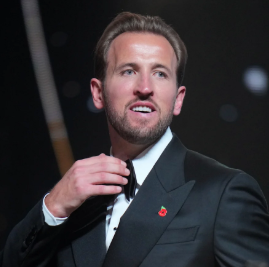
The rain falling outside London Palladium Theatre on October twenty-sixth twenty twenty-six did nothing to dampen the roar that echoed through Argyll Street as Harry Kane stepped out of his black luxury sedan. Inside the historic West End auditorium, decorated in gold gilding and velvet curtains, football royalty had gathered for the seventieth annual Ballon d’Or ceremony. For twenty-five years, English football had waited for this exact moment. Not since Michael Owen raised the golden sphere in two thousand one had a player from the birthplace of the game stood atop the global podium.
When presenter Ruud Gullit tore open the envelope and pronounced the name Harry Kane, three thousand spectators inside the theatre rose to their feet in a standing ovation. Beside him, his wife Kate wiped tears from her eyes as Kane walked up the carpeted steps toward the stage. The thirty-three-year-old Bayern Munich striker and England captain looked around the auditorium, taking a deep breath before accepting the six-kilogram solid brass trophy from French football legend Zinedine Zidane.
For Harry Kane, this crowning achievement represented the culmination of a extraordinary journey. Over the course of the two thousand twenty-five and two thousand twenty-six football campaign, the London-born forward produced numbers that defied modern sports analytics. Across fifty-four appearances for club and country, Kane struck seventy-three goals and provided eighteen assists, leading Bayern Munich to the Bundesliga title and captaining England through a dramatic international run.
In his acceptance speech, Kane spoke with characteristic modesty, expressing profound gratitude to his teammates, coaches, and family. He recalled standing on municipal pitches in Walthamstow as a young boy, told by academy directors that he lacked the speed and explosive acceleration required for top-tier professional football. Holding football most coveted individual award in his hands in the heart of his hometown, those early doubts vanished into history.
The victory ended decades of disappointment for English supporters who watched generations of world-class talent, including Steven Gerrard, Frank Lampard, Wayne Rooney, and David Beckham, fall short of the top prize. Kane secured his triumph by outpolling two of the game most electrifying talents, Barcelona teenage sensation Lamine Yamal and Real Madrid French superstar Kylian Mbappe. The voting panel of one hundred international journalists delivered a decisive verdict, confirming that Kane relentless goal scoring efficiency, tactical intelligence, and leadership made him the undisputed king of world football.
The Seventy Three Goal Season That Silenced Every Doubter Across Europe
To understand how Harry Kane secured the two thousand twenty-six Ballon d’Or, one must examine the breathtaking consistency of his scoring record over twelve relentless months. The two thousand twenty-five and two thousand twenty-six football calendar began with high expectations at Bayern Munich, where manager Vincent Kompany built a high-pressing offensive system designed around Kane movement and distribution.
From the opening match of the Bundesliga season, Kane unleashed an offensive display that shattered records across German football. In his first ten league matches, he netted seventeen goals, including consecutive hat-tricks against Borussia Dortmund and Bayer Leverkusen. His ability to drop deep into midfield, draw central defenders out of position, and spray precise sixty-yard passes to wide forwards turned Bayern into an unstoppable attacking engine.
In European competition, Kane was equally dominant. During the UEFA Champions League group phase, he scored eleven goals in eight matches, including a memorable four-goal performance against Italian giants Inter Milan at the Allianz Arena. Opposing managers openly admitted that preparing for Kane had become a tactical nightmare. If defenders tight-marked him inside the penalty box, he created space for teammates. If they dropped off to cover runners, he unleashed lethal long-range shots with either foot.
By the time the domestic league season concluded in May, Kane had netted forty-five goals in thirty-four Bundesliga fixtures, shattering the scoring metrics established by legendary predecessors. He comfortably won his second consecutive European Golden Shoe, finishing well ahead of his closest continental rivals. His individual brilliancy was matched by team hardware as Bayern reclaimed the German championship trophy in front of seventy-five thousand cheering supporters in Munich.
International duty with England provided the final piece of Kane Ballon d’Or campaign. Serving as captain under the national team coaching staff, Kane scored twelve goals during qualification and international tournament fixtures. His leadership on and off the pitch proved vital as he guided a young English squad through high-pressure knockout encounters. Across the entire season, Kane averaged a goal or assist every sixty-two minutes played, establishing an offensive standard that voters simply could not ignore.
Inside the London Palladium Auditorium on Award Night
The atmosphere inside the London Palladium on Monday evening carried the electric energy of a landmark theatrical premiere. Red carpet arrivals featured a star-studded coalition of global sports icons, Hollywood celebrities, and European football executives. Fans lined the surrounding streets four deep, waving England flags and chanting Kane name as team buses arrived at the venue.
Inside the auditorium, seating arrangements placed Kane in the front row alongside his fellow nominees Lamine Yamal, Kylian Mbappe, Jude Bellingham, and Rodri. The evening began with musical performances and tribute videos displaying the top individual moments from the past season. When highlights of Kane season flashed across the giant auditorium screens, displaying his spectacular sixty-yard lob goal from the center circle and his clinical penalty strikes, applause erupted throughout the hall.
Interviews conducted throughout the ceremony emphasized the high esteem in which Kane is held by his peers. Former England manager Gareth Southgate praised Kane work ethic and mental toughness, noting that his journey from lower-league loan spells to global superstardom offered an inspiring lesson for aspiring young athletes worldwide. German football legend Lothar Matthaeus highlighted Kane tactical maturity, calling him the most complete modern forward in the sport.
When the final announcement arrived at nine forty-five local time, the reaction inside the Palladium was instantaneous. Delegates from Bayern Munich and the English Football Association stood up to celebrate, while fans watching on big screens in public squares across London cheered wildly. Kane took the stage with poise, taking a moment to applaud his fellow nominees before addressing the global broadcast audience of over one hundred million viewers.
He dedicated the trophy to his late grandfather, who took him to his first matches at White Hart Lane, and paid tribute to the grassroots coaches who believed in his potential during his formative years in North London. The image of Kane lifting the heavy gold trophy against the backdrop of the London Palladium stage instantly became an iconic chapter in British sports history.
From Ridgeway Rovers to Arsenal Rejection and the Making of a Striker
The roots of Harry Kane football story lie in the working-class neighborhood of Chingford in East London, just miles from where he would eventually achieve global stardom. Born in July nineteen ninety-three, Kane grew up in a family passionately devoted to sport. His mother Kim and father Pat encouraged his athletic pursuits from an early age, enrolling him with local youth club Ridgeway Rovers when he was just six years old.
It was at Ridgeway Rovers, the same grassroots club that produced David Beckham, where coaches first noticed Kane natural knack for finding the back of the net. Despite his enthusiasm, Kane was far from an obvious athletic prodigy. He lacked natural speed and was heavier than many of his peers, relying instead on quick thinking, sharp spatial awareness, and an unyielding desire to practice shooting against garage doors for hours every afternoon.
At age eight, Kane received his first big opportunity when scouts from Arsenal youth academy invited him to join their development program. However, his stint with Tottenham North London rivals was short-lived. After just one season, Arsenal academy staff released the young forward, citing concerns over his lack of mobility and slow physical development. The rejection hit the young boy hard, but it sparked a fierce internal determination that would define his entire career.
Following brief training spells with Watford, Kane joined the youth academy at Tottenham Hotspur in two thousand four at age eleven. Tottenham youth coaches, led by Alex Inglethorpe and Bradley Allen, recognized something special beneath Kane awkward physical frame. While he was not the fastest runner on the pitch, his ball striking technique with both feet was exceptional, and his obsession with self-improvement set him apart from every other prospect in his age group.
During his teenage years at Tottenham Lodge Manor training ground, Kane spent countless extra hours practicing extra finishing drills, studying video tape of legendary strikers like Teddy Sheringham and Alan Shearer, and working with fitness coaches to build functional strength. His coaches noted that while other talented academy players relied solely on raw athletic gifts, Kane built his game on intellectual understanding, tactical positioning, and relentless repetition.
The Millwall and Leicester Loan Spells That Forged Iron Resilience
Transitioning from academy football to the physical realities of men professional leagues is often where promising young careers stall. For Harry Kane, that trial came through four distinct loan spells across the lower divisions of English football between two thousand eleven and two thousand thirteen.
His first assignment took him to Leyton Orient in League One during the second half of the two thousand ten and two thousand eleven season. At just seventeen years old, Kane made his professional debut against Rochdale, scoring five goals in eighteen appearances and experiencing the bruising physical aerial battles of lower-league competition. The experience taught him how to use his body to shield the ball against experienced, veteran central defenders.
In January two thousand twelve, Tottenham sent Kane on loan to Millwall in the English Championship. The New Den in South London was notorious for its intimidating atmosphere and demanding fanbase. Entering a fierce relegation battle, the eighteen-year-old forward embraced the pressure. Kane scored nine goals in twenty-seven matches for Millwall, earning the club Young Player of the Year award and helping secure their Championship status. Millwall supporters quickly grew to admire his fearless attitude and willingness to compete for every header.
Subsequent loan spells at Norwich City in the Premier League and Leicester City in the Championship proved more challenging. A serious ankle injury disrupted his time at Norwich, limiting him to just three appearances. At Leicester during the spring of two thousand thirteen, Kane found himself starting on the substitutes bench alongside future England teammate Jamie Vardy. Sitting on the bench at King Power Stadium, watching matches pass him by, Kane resolved that once he returned to Tottenham, he would never accept being a secondary option again.
Those loan spells forged a mental toughness that money cannot buy. While many modern academy stars are sheltered in elite training facilities, Kane earned his stripes in cold, windy Tuesday night matches in South London and the Midlands. He learned how to handle hostile crowds, physical defending, and the constant psychological threat of failure. When he returned to Tottenham for the two thousand thirteen and two thousand fourteen season, he was no longer an unproven academy boy; he was a hardened professional ready to compete at the highest level.
Tottenham Hotspur and the Rise of Football Most Complete Number Nine
Harry Kane breakthrough at Tottenham Hotspur arrived during the two thousand fourteen and two thousand fifteen season under the guidance of newly appointed manager Mauricio Pochettino. The Argentine coach introduced a high-intensity pressing philosophy that demanded extraordinary physical conditioning and tactical discipline. Pochettino saw in Kane a striker who possessed both the work ethic to lead a defensive press and the lethal finishing ability to capitalize on turnover opportunities.
Kane rewarded Pochettino trust with a breakout campaign that captured the imagination of Premier League fans. On November second two thousand fourteen, Kane came off the bench to score a dramatic deflected free-kick winner against Aston Villa. That goal earned him a permanent spot in Tottenham starting lineup, and he never looked back. Kane went on to score thirty goals in all competitions that season, including a memorable two-goal performance in a five-two victory over Chelsea on New Year Day two thousand fifteen. He was named PFA Young Player of the Year and earned his first senior England call-up.
Over the next eight seasons at Tottenham, Kane established himself as one of the most prolific strikers in Premier League history. He won three Premier League Golden Boots in two thousand sixteen, two thousand seventeen, and two thousand twenty-one. His partnership with South Korean winger Son Heung-min became the most lethal duo in Premier League history, combining for forty-seven direct goal combinations and breaking the long-standing record previously held by Frank Lampard and Didier Drogba.
What made Kane truly unique during his time at Tottenham was his tactical evolution. Under Jose Mourinho during the two thousand twenty and two thousand twenty-one season, Kane dropped deeper into the midfield zones, acting as a hybrid number ten playmaker. That season, he accomplished the rare feat of finishing as both the Premier League top goalscorer with twenty-three goals and top assist provider with fourteen assists. He was no longer just a classic target man; he had become a complete attacking architect capable of unlocking any defense in world football.
Breaking Wayne Rooney Record to Become England All Time Leading Scorer
Harry Kane relationship with the England national team has been defined by momentous milestones and unwavering leadership. His international journey began in March two thousand fifteen, when he made his debut as a second-half substitute against Lithuania at Wembley Stadium. Just seventy-nine seconds after stepping onto the pitch, Kane scored with his very first touch, heading home a cross from Raheem Sterling to ignite a celebration that signaled the arrival of a new era.
By two thousand eighteen, manager Gareth Southgate appointed Kane as England captain ahead of the FIFA World Cup in Russia. At just twenty-four years old, Kane embraced the responsibility of leading one of the youngest squads in the tournament. He delivered a heroic performance, scoring six goals, including a dramatic late winner against Tunisia and a hat-trick against Panama, to win the World Cup Golden Boot and guide England to their first World Cup semi-final in twenty-eight years.
Kane pursuit of Sir Bobby Charlton and Wayne Rooney national scoring records became a central narrative of English football over the subsequent five years. Goal by goal, Kane closed the distance on Rooney record of fifty-three international goals. The historic moment arrived on March twenty-third two thousand twenty-three during a European Championship qualifier against Italy at the Stadio Diego Armando Maradona in Naples.
With England leading one-zero late in the first half, Declan Rice won a penalty. Kane stepped up to the spot under immense pressure, keeping his composure to fire the ball past Italian goalkeeper Gianluigi Donnarumma into the top corner. The goal marked his fifty-fourth for England, officially breaking Wayne Rooney record and establishing Harry Kane as the all-time leading goalscorer in Three Lions history.
As England captain, Kane continued to break records through the two thousand twenty-four European Championship and two thousand twenty-six World Cup qualifiers, extending his international goal tally beyond sixty-eight goals. His ability to deliver in high-stakes international fixtures, combined with his selfless leadership, earned him universal respect from teammates and supporters alike. His Ballon d’Or victory in two thousand twenty-six served as the ultimate international validation for a player who had carried his nation hopes on his shoulders for over a decade.
The High Stakes One Hundred Million Euro Transfer to Bayern Munich
In August two thousand twenty-three, after scoring two hundred and eighty goals in four hundred and thirty-five matches for Tottenham Hotspur, Harry Kane faced the most decisive decision of his professional career. Despite individual accolades and standing as Tottenham all-time leading goalscorer, he had yet to win a major team trophy. With one year remaining on his contract, European heavyweights Bayern Munich launched an aggressive pursuit to bring the England captain to Germany.
Negotiations between Bayern CEO Jan-Christian Dreesen and Tottenham chairman Daniel Levy dragged on for weeks, dominating international sports headlines. Finally, on August eleventh two thousand twenty-three, the clubs agreed to a record-breaking transfer package exceeding one hundred million euros, making Kane the most expensive signing in Bundesliga history.
The pressure on Kane as he arrived in Munich was immense. Bayern Munich had spent a record fee on a thirty-year-old striker to fill the void left by Robert Lewandowski exit a year prior. German media questioned whether an English player could adapt quickly to the cultural, tactical, and linguistic demands of the Bundesliga. Kane answered those questions instantly on his league debut, scoring a goal and providing an assist in a four-zero victory against Werder Bremen.
Behind the scenes, Kane integrated seamlessly into the Bayern squad. He threw himself into learning German, relocated his family to Munich, and immediately earned the respect of senior dressing room figures like Thomas Mueller, Manuel Neuer, and Joshua Kimmich. His professionalism and humble demeanor won over the Bayern fanbase, who embraced the English striker as one of their own.
Conquering the Bundesliga and Lifting the European Golden Shoe
Harry Kane debut season in Germany delivered one of the most remarkable individual goal-scoring campaigns in European football history. From the moment he put on the famous red shirt of Bayern Munich, Kane turned the Bundesliga into his personal stage, producing extraordinary goal returns week after week.
In his first sixteen league appearances, Kane scored twenty-one goals, breaking the previous record for the fastest player to reach twenty Bundesliga goals, held by Erling Haaland. His goal repertoire featured spectacular strikes, including an unforgettable sixty-yard chip from his own half against Darmstadt that was named Bundesliga Goal of the Season. He also netted hat-tricks against VfL Bochum, Darmstadt, and eternal rivals Borussia Dortmund in his very first Der Klassiker appearance at Westfalenstadion.
By the end of his debut two thousand twenty-three and two thousand twenty-four season, Kane had scored thirty-six league goals in thirty-two matches, capturing the Torjaegerkanone as Bundesliga top scorer and winning his first European Golden Shoe award as the top league goalscorer across all European domestic divisions. His goal tally was the highest ever recorded by a player in their debut Bundesliga season.
Kane carried that blistering form directly into the two thousand twenty-five and two thousand twenty-six season. Working alongside new manager Vincent Kompany, Kane boosted his game to even greater heights. He scored forty-five goals in all competitions, leading Bayern to the German championship title and cementing his status as the premier center-forward in world football. That remarkable domestic and European scoring run formed the rock-solid foundation for his two thousand twenty-six Ballon d’Or triumph.
The Battle Against Lamine Yamal and Kylian Mbappe for Football Highest Honor
The race for the two thousand twenty-six Ballon d’Or developed into one of the most compelling three-way contests in modern sports history. Across global media, pundits debated the relative merits of three extraordinary athletes: the veteran consistency of Harry Kane, the mesmerizing flair of Barcelona teenage sensation Lamine Yamal, and the explosive athleticism of Real Madrid French superstar Kylian Mbappe.
Lamine Yamal had enjoyed a breathtaking twelve months, establishing himself as the primary creative force for both Barcelona and the Spanish national team. At just nineteen years old, Yamal registered twenty-two assists and eighteen goals, captivating fans with his dribbling ability, vision, and big-match temperament. Many international journalists advocated strongly for the young Spaniard, arguing that his individual brilliance represented the future of European football.
Meanwhile, Kylian Mbappe produced another monster goal-scoring campaign in his second season at Real Madrid. The French captain scored forty-two goals across La Liga and the UEFA Champions League, helping Real Madrid secure major hardware and delivering decisive performances in high-profile fixtures. Mbappe raw speed and big-game pedigree made him a formidable candidate in the eyes of many voters across South America and Africa.
Ultimately, the voting panel of one hundred top international journalists awarded the top prize to Harry Kane based on his unmatched complete statistical profile and team influence. Kane seventy-three combined goals and assists exceeded the individual output of both Yamal and Mbappe. In addition, Kane ability to combine elite goal scoring with deep playmaking and international captaincy provided a holistic impact that voters recognized as truly exceptional.
When the voting point totals were officially released by France Football following the ceremony, Kane secured first place with four hundred and eighty-two points, ahead of Yamal in second place with four hundred and twelve points and Mbappe in third place with three hundred and ninety-five points. The clear margin demonstrated that international football consensus recognized Kane as the preeminent player in world football.
Sir Stanley Matthews Bobby Charlton Kevin Keegan and Michael Owen: The English Pantheon
Harry Kane two thousand twenty-six Ballon d’Or victory placed him in the most exclusive company in British sports history. Prior to Kane triumph, only four Englishmen had ever claimed football highest individual honor since the award creation by France Football magazine in nineteen fifty-six.
The inaugural Ballon d’Or in nineteen fifty-six was awarded to Sir Stanley Matthews, the legendary Blackpool winger known as the Wizard of the Dribble. Matthews won the award at age forty-one, honoring a career defined by sportsmanship, longevity, and supreme wing play that thrilled supporters across post-war Britain.
Ten years later, in nineteen sixty-six, Sir Bobby Charlton claimed the trophy after inspiring England to their historic FIFA World Cup victory at Wembley Stadium. Charlton thunderous long-range strikes, graceful midfield movement, and quiet dignity made him an iconic ambassador for Manchester United and English football worldwide.
In nineteen seventy-eight and nineteen seventy-nine, Kevin Keegan became the first and only Englishman to win back-to-back Ballon d’Or titles. Playing for German giants Hamburger SV, the dynamic forward captured the imagination of European football with his explosive movement, aerial bravery, and relentless pressing style that turned HSV into European champions.
The most recent English winner before Kane was Michael Owen in two thousand one. At just twenty-one years old, the Liverpool sensation took Europe by storm, scoring a hat-trick against Germany in Munich and leading Liverpool to a historic five-trophy cup treble with his electric pace and clinical finishing.
By joining Matthews, Charlton, Keegan, and Owen, Harry Kane became the fifth English footballer to lift the Golden Ball. His victory ended a twenty-five-year drought and reaffirmed that English talent remains at the apex of global football. Kane name is now permanently etched alongside these immortal figures in the annals of sporting history.
Deconstructing Harry Kane Tactical Evolution from Goal Poacher to Deep Playmaker
Analyzing Harry Kane evolution over his twelve-year professional career reveals a fascinating tactical evolution. Early in his senior career at Tottenham Hotspur, Kane operated primarily as a traditional number nine target man. He positioned himself between opposition central defenders, using his physical strength to hold up play and relying on sharp instincts inside the penalty box.
However, as opposing defenses began employing low defensive blocks to deny him space in the box, Kane adapted his game in ways few traditional forwards ever manage. During the two thousand nineteen and two thousand twenty season under Jose Mourinho, Kane began dropping ten to fifteen yards deeper into the central midfield channel. That subtle positional shift disrupted opposition defensive structures, forcing central defenders to either abandon their line to follow him or allow him space to turn and face forward.
Once Kane turned in the central pocket, his elite vision and passing range turned him into a deep-lying playmaker. He developed an almost telepathic understanding with wide runners, dropping exquisite sixty-yard diagonal passes behind opposition fullbacks. His ability to hit long-range passes with equal precision using either foot made him as dangerous fifteen yards inside his own half as he was inside the six-yard box.
At Bayern Munich, managers Thomas Tuchel and Vincent Kompany refined this dual-role concept further. In Kompany offensive scheme, Kane operates as a complete false-nine hybrid. He initiates pressing triggers from the front, drops deep to construct passing combinations with attacking midfielders, and still arrives inside the penalty box to finish chances. This rare combination of a world-class goalscorer and a visionary playmaker is what truly lifts Kane into the highest tier of modern footballing greats.
The Physics of Striking: Footwork Body Positioning and Long Range Finishes
Sports biomechanists and technical shooting coaches frequently study Harry Kane goal-scoring mechanics as a masterclass in human performance and footwork execution. Unlike forwards who rely on explosive speed or sheer acrobatic athleticism, Kane relies on flawless biomechanical technique, precise body angle adjustments, and exceptional peripheral vision.
A fundamental aspect of Kane shooting technique is his minimal backswing. When receiving the ball inside tight penalty box spaces, Kane requires virtually no setup touch before striking. By planting his non-kicking foot firmly adjacent to the ball and locking his ankle joint at ninety degrees, he generates maximum kinetic force through hip rotation rather than a wide leg swing. This technique allows him to release lethal shots before opposing defenders can block the passing lane or goalkeepers can set their stance.
In addition, Kane exhibits complete ambidexterity when finishing. Statistically, over thirty-five percent of his career goals have been scored with his left foot, making him virtually impossible to force onto a weak side. Whether taking a first-time volley with his right foot or curling a left-footed strike into the far top corner from twenty-five yards out, his footwork balance remains impeccably centered.
His long-range finishing from outside the penalty arc relies on striking the valve of the football with the instep bone of his foot, imparting a top-spin trajectory that causes the ball to dip sharply over diving goalkeepers. His famous sixty-yard goal against Darmstadt from inside his own half demonstrated his instant spatial awareness; noticing the opposition goalkeeper three yards off his line, Kane struck the ball with perfect power and trajectory without pausing to look down at his feet.
Penalties represent another area where Kane technical mastery stands supreme. Converting over eighty-nine percent of his career spot-kicks, Kane utilizes a stride pattern that allows him to observe the goalkeeper movement until his final plant step. He can snap his wrist and ankle to reverse his shot direction at the last fraction of a second, firing penalties into the extreme top corners with power that renders diving saves impossible.
Leadership Under Pressure: Captaining England Through International Tournaments
Leading the England national football team comes with an intense level of public scrutiny and expectation unmatched in international sports. When Harry Kane was handed the captain armband by Gareth Southgate in May two thousand eighteen, he inherited a squad haunted by decades of tournament heartbreak, penalty shootout exits, and tabloid pressure.
Kane approach to international captaincy has been defined by calm authority, emotional intelligence, and lead-by-example standards. Rather than delivering aggressive pre-match speeches, Kane leads through meticulous preparation, elite training standards, and personal accessibility. Younger international squad members, including Jude Bellingham, Bukayo Saka, and Phil Foden, have repeatedly cited Kane mentorship as a decisive factor in their seamless integration into senior international football.
During high-pressure tournament moments, Kane composure has proven vital. In the two thousand twenty-one European Championship semi-final against Denmark at a packed Wembley Stadium, with England trailing one-zero, Kane drove his team forward, dropping deep to link play before scoring the winning goal in extra time to send England to their first European final in history.
Similarly, during the two thousand twenty-four European Championship and subsequent international qualification cycles, Kane handled tactical adjustments and media scrutiny with quiet dignity. He absorbed public criticism on behalf of his younger teammates, protecting the squad from media distraction and maintaining a unified, positive camp culture.
Beyond his tactical contributions, Kane leadership turned the relationship between the England squad and the public. Under his captaincy, the national team built a transparent, humble, and inclusive culture that reconnected millions of fans across the country with the Three Lions shirt. His Ballon d’Or trophy victory stands as a proof to the power of resilient, selfless leadership in modern athletics.
Thomas Tuchel Vincent Kompany and the Tactical Blueprint at Bayern Munich
Harry Kane transition to German football was facilitated by two world-class managerial minds: Thomas Tuchel, who originally engineered his transfer to Bavaria, and Vincent Kompany, who succeeded Tuchel and boosted Bayern offensive system to historic heights.
Thomas Tuchel recognized that bringing Kane to Bayern Munich required updating the team transition mechanics. Under Tuchel tactical guidance during the two thousand twenty-three and two thousand twenty-four season, Kane served as the central focal point around which fast wingers Leroy Sane, Kingsley Coman, and Serge Gnabry operated. Tuchel deployed Kane to draw opposing central defenders toward the ball, opening massive vertical channels for inverted wing runs.
When Vincent Kompany assumed managerial duties at Bayern Munich in the summer of two thousand twenty-four, he expanded Kane role even further. Kompany implemented an aggressive fluid-pressing system that relied on Kane tactical intelligence to lead the high press. Offensively, Kompany gave Kane total freedom to roam across the attacking third, encouraging him to swap positions with attacking midfielder Jamal Musiala.
This fluid partnership between Kane and Musiala became the defining feature of Bayern play during their championship campaign. When Musiala pushed forward into the number nine space, Kane dropped into midfield to act as the primary passer. When Kane attacked the penalty box, Musiala provided defensive coverage and late box runs. This dynamic structure yielded eighty-five goals between the pair across all competitions, creating an offensive juggernaut that dominated German and European football.
Kompany public praise for Kane emphasized his defensive work rate and tactical discipline. The Belgian manager noted that despite his status as a global superstar, Kane consistently ranked among the team leaders in defensive distance covered, shot blocks, and ball recoveries in the defensive third. That selfless commitment to team success endeared Kane to his coaches and solidified his reputation as a modern football icon.
The English Football Renaissance and the Global Stature of Three Lions Stars
Harry Kane Ballon d’Or victory in two thousand twenty-six marked the golden pinnacle of a broader renaissance across English football. Over the preceding decade, systemic investments in youth academy infrastructure, coaching education, and tactical innovation turned the nation footballing arena from an insular, physicality-focused culture into a powerhouse of technical excellence.
In the nineteen nineties and early two thousands, English talent was frequently criticized for lacking tactical flexibility and technical composure when competing against technical giants from Spain, Italy, and Brazil. However, the implementation of the Elite Player Performance Plan in two thousand twelve completely overhauled youth development across premier league clubs. Facilities were modernized, video analysis was integrated at early age groups, and young players were taught small-sided possession mechanics.
Harry Kane triumph stands alongside the global ascendance of an elite generation of English talent. Players like Jude Bellingham at Real Madrid, Phil Foden at Manchester City, Bukayo Saka at Arsenal, and Declan Rice have established themselves as foundational superstars at top European clubs. For the first time in modern history, English players are regularly competing for and winning major individual honors across continental leagues.
In addition, Kane decision to move abroad to Bayern Munich shattered the traditional English preference for remaining within domestic comfort zones. By proving that an England captain could move to a legendary foreign club, master the language and culture, and dominate European football, Kane blazed a trail for future generations of British athletes seeking international greatness.
The impact on public enthusiasm across the United Kingdom has been profound. Youth participation rates in grassroots football clubs have surged, while ratings for international fixtures have reached historic highs. Kane individual recognition serves as proof that the long-term structural reforms within English football have succeeded at the highest possible level.
Comparative Breakdown of Modern Ballon d Or Winners and Historic Goal Tallys
Comparing Harry Kane two thousand twenty-six Ballon d’Or winning campaign against historic performances reveals the extraordinary statistical standards he achieved. In an era following the dominance of Lionel Messi and Cristiano Ronaldo, Kane established individual scoring benchmark totals that place him among the greatest individual seasons ever recorded.
During his seventy-three goal-and-assist campaign across fifty-four matches, Kane averaged one point three five goal contributions per game. This places his two thousand twenty-five and two thousand twenty-six season ahead of Karim Benzema two thousand twenty-two Ballon d’Or campaign with fifty-nine goal contributions in forty-six matches, and Luka Modric two thousand eighteen winning season.
Looking back across Ballon d’Or history, Kane seventy-three combined goals and assists stands as the highest individual total produced by an English winner. Sir Stanley Matthews captured the inaugural award in nineteen fifty-six based on artistic wing mastery rather than high goal totals. Sir Bobby Charlton won in nineteen sixty-six with twenty-three goals across all competitions. Kevin Keegan captured his back-to-back awards in nineteen seventy-eight and nineteen seventy-nine with twenty-eight and thirty-two goals respectively, while Michael Owen claimed the trophy in two thousand one with thirty-one goals.
In addition to overall goal volume, Kane efficiency statistics set him apart. His shot conversion rate of twenty-seven point eight percent in the Bundesliga was the highest among all strikers in Europe top five leagues. In addition, his passing accuracy of eighty-four point two percent in the opposition half exceeded every other natural center-forward nominated for the award.
These numbers demonstrate that Kane Ballon d’Or was not merely a sentimental lifetime achievement award; it was a merit-based triumph earned through absolute dominance across every statistical category measuring offensive performance.
Biographies of Primary Figures Shaping Harry Kane Career and Triumph
Understanding Harry Kane path to the two thousand twenty-six Ballon d’Or requires examining the influential individuals who guided, mentored, and supported him at critical junctures of his life and career.
Kate Kane, his wife and lifelong companion, met Harry during their schooldays at Chingford Foundation School when both were just eleven years old. Through his loan spells at Leyton Orient and Millwall, his rise at Tottenham Hotspur, and his high-profile move to Munich, Kate provided an unwavering foundation of personal stability. Together, they raise their four children, maintaining a quiet, family-centered lifestyle far removed from the sensationalist celebrity culture often associated with professional sports stars.
Mauricio Pochettino, the Argentine manager who took charge of Tottenham Hotspur in two thousand fourteen, served as the primary architect of Kane professional breakthrough. Pochettino recognized Kane hidden potential, enforcing a grueling physical fitness regimen and instilling the mental self-belief necessary to compete against elite defenders. Under Pochettino guidance, Kane evolved from a promising academy graduate into a world-class Premier League striker.
Gareth Southgate, the long-serving England national team manager, played a decisive role in establishing Kane as a global sporting leader. Southgate named Kane national team captain in two thousand eighteen, empowering him to lead the squad culture and defending him against media scrutiny. Their close working relationship over six major international tournaments built the foundation for England historic modern era.
Vincent Kompany, the former Manchester City legend who assumed the managerial reins at Bayern Munich in two thousand twenty-four, unlocked the final, most complete version of Kane game. Kompany fluid tactical system gave Kane freedom to drop deep and construct attacking plays while continuing to dominate inside the box. Kompany public advocacy and tactical backing were instrumental in securing Kane the two thousand twenty-six Ballon d’Or.
Frequently Asked Questions Regarding Harry Kane Ballon d Or Victory
Who was the last Englishman to win the Ballon d’Or before Harry Kane? Michael Owen was the last Englishman to win the Ballon d’Or in two thousand one while playing as a forward for Liverpool. Owen captured the award after leading Liverpool to a cup treble and scoring a memorable hat-trick for England against Germany in Munich. Prior to Owen, the only English winners were Sir Stanley Matthews in nineteen fifty-six, Sir Bobby Charlton in nineteen sixty-six, and Kevin Keegan in nineteen seventy-eight and nineteen seventy-nine.
How many goals did Harry Kane score during his two thousand twenty-six Ballon d’Or winning season? Harry Kane produced an astonishing seventy-three combined goal contributions across fifty-four appearances for club and country during the two thousand twenty-five and two thousand twenty-six season. This included forty-five goals for Bayern Munich in domestic and European competitions, twelve goals for the England national team, and eighteen direct assists for his teammates.
Who were the runner-up candidates for the two thousand twenty-six Ballon d’Or? Harry Kane secured first place in the voting panel with four hundred and eighty-two points. Barcelona Spanish teenage winger Lamine Yamal finished in second place with four hundred and twelve points after an incredible season featuring eighteen goals and twenty-two assists. Real Madrid French forward Kylian Mbappe finished third with three hundred and ninety-five points following a forty-two goal campaign.
What major trophies did Harry Kane win to support his Ballon d’Or bid? During the two thousand twenty-five and two thousand twenty-six campaign, Harry Kane led Bayern Munich to the German Bundesliga title and reached the final stages of the UEFA Champions League. He also won his second consecutive European Golden Shoe as Europe top domestic league goalscorer and captained England through a successful international campaign.
Where was the two thousand twenty-six Ballon d’Or ceremony held? The seventieth annual Ballon d’Or ceremony was hosted at the historic London Palladium Theatre in West End, London, on October twenty-sixth twenty twenty-six. Hosting the event in London provided a homecoming backdrop for Kane, who was born and raised in North London just miles from the venue.
Media Reaction Across Fleet Street European Sports Dailies and Global Press
The news of Harry Kane Ballon d’Or victory triggered a tidal wave of celebratory coverage across British newspapers, European sports dailies, and international media networks. Headlines from London to Munich hailed the outcome as a triumph of dedication, professional ethics, and sporting perfection.
In the United Kingdom, Fleet Street newspapers celebrated the end of England twenty-five-year drought with commemorative editions. The Times published a front-page photograph of Kane holding the golden sphere under the headline Golden King Harry, praising his journey from lower-league loan spells to global supremacy. The Daily Telegraph highlighted his evolution into football most complete central forward, declaring that Kane victory restored English football to its rightful place at the pinnacle of international sport.
German media outlets were equally enthusiastic in their praise for the Bayern Munich forward. Munich daily newspaper Sueddeutsche Zeitung praised Kane humility and technical brilliance, noting that his arrival had boosted the entire reputation of the Bundesliga. Sport Bild published a comprehensive analytical piece detailing his tactical partnership with Jamal Musiala, declaring Kane the most impactful foreign signing in German football history.
Across Europe, influential sports dailies echoed the sentiment. French publication L’Equipe, whose sister magazine France Football created the award, ran a multi-page retrospective on Kane career, describing him as a timeless craftsman who won through intelligence, technique, and ruthless efficiency rather than superficial glamour. Italian newspaper La Gazzetta dello Sport praised his spatial awareness and ambidextrous striking, calling him the absolute ideal modern center-forward.
In North America and South America, major sports broadcasters analyzed Kane victory as a victory for fundamentals and longevity. Commentators noted that in an era often obsessed with viral social media clips and raw speed, Kane triumph proved that tactical understanding, footwork precision, and mental resilience remain the ultimate currencies of elite athletic performance.
The Cultural Legacy of Harry Kane and the Future of English Football
Beyond the shiny gold brass trophy and the statistical records, Harry Kane two thousand twenty-six Ballon d’Or victory leaves a profound cultural legacy that will shape English football for generations to come. His story stands as a symbol of hope for young athletes who do not fit the traditional mold of early athletic prodigies.
In an era where sports academies often prioritize raw physical speed and early physical dominance, Kane path demonstrates the supreme value of patience, work ethic, and intellectual mastery. Rejected by Arsenal at age eight, sent on cold winter loans to Leyton Orient and Millwall, and overlooked by national youth teams, Kane never allowed external doubt to define his boundaries. He focused on what he could control: extra hours on the practice pitch, video study, physical conditioning, and mental resilience.
For grassroots football in Britain, Kane triumph provides an invaluable educational tool. Youth coaches across the nation point to Kane as proof that greatness is made, not born. His dedication to practicing finishing with both feet, his selfless teamwork, and his dignified conduct off the pitch offer a healthy alternative to the flashy, self-centered behavior that sometimes taints professional sports culture.
In addition, Kane victory accelerates the ongoing globalization of British football talent. By proving that an English player can move to one of continental Europe most demanding clubs, conquer the domestic league, and claim the world top individual honor, Kane opened new horizons for ambitious young British athletes.
As Kane continues his career with Bayern Munich and the England national team, his place in football history is secure. He is no longer just Chingford boy who made good, nor is he merely Tottenham or Bayern legendary goalscorer. Harry Kane is a Ballon d’Or winner, an immortal figure in the pantheon of world sport, and a shining symbol of what can be achieved through relentless pursuit of excellence.
The Historical Evolution of the Ballon d Or Award Since Nineteen Fifty Six
To fully appreciate the significance of Harry Kane two thousand twenty-six triumph, one must understand the rich seventy-year history of the Ballon d’Or itself. Created in nineteen fifty-six by Gabriel Hanot, the visionary editor of France Football magazine, the award was established to honor the standout European footballer of the year based on voting by respected sports journalists across the continent.
In its early decades, the Ballon d’Or was restricted exclusively to European players playing at European clubs. This era saw legendary icons like Alfredo Di Stefano, Raymond Kopa, Eusebio, Gianni Rivera, and Johan Cruyff lift the trophy. Cruyff, the master of Dutch Total Football, became the first player to win the award three times in nineteen seventy-one, nineteen seventy-three, and nineteen seventy-four, establishing a benchmark of sustained brilliance that stood for decades.
In nineteen ninety-five, France Football expanded the voting rules to allow non-European players active at European clubs to be eligible for nomination. This historic change immediately bore fruit when Liberian superstar George Weah claimed the trophy in nineteen ninety-five after a sensational season with AC Milan. The award expanded further in two thousand seven, becoming a truly global honor open to players from any club or continent worldwide.
Over the past two decades, the Ballon d’Or experienced an unprecedented era dominated by Lionel Messi and Cristiano Ronaldo, who collectively won thirteen trophies between two thousand eight and two thousand twenty-three. Their rivalry boosted global media interest in the award to unprecedented levels, making the annual ceremony a global entertainment spectacle watched by tens of millions.
Harry Kane entry into this legendary lineage in two thousand twenty-six represents a return to classical footballing values. His victory honors a traditional number nine who mastered both physical finishing and tactical playmaking, proving that amidst evolving tactical trends, complete footballing mastery remains the ultimate standard of athletic achievement.
Youth Academy Coaching Philosophy and the Early Detection of Talent
The story of Harry Kane early rejection by Arsenal at age eight and his eventual success at Tottenham Hotspur has triggered an ongoing debate among sports scientists, academy directors, and youth talent scouts regarding early talent identification.
For decades, traditional youth academies heavily favored early maturing athletes who possessed superior physical speed, height, and power relative to their peers. Young players who were smaller or slower were frequently cut from development programs, regardless of their technical foundation or tactical understanding. Kane early struggles at Arsenal and Watford highlighted the fundamental flaws of this short-sighted assessment model.
Modern sports science now recognizes that physical growth spurts occur at vastly different ages, whereas technical mechanics and psychological resilience must be nurtured continuously throughout childhood. Former Tottenham academy director Alex Inglethorpe emphasized that what made Kane unique was not his physical profile at age twelve, but his extraordinary capacity for deliberate practice and learning.
Inglethorpe introduced tracking metrics at Tottenham that measured a player willingness to practice unprompted, their response to constructive criticism, and their ability to solve tactical problems on the pitch independently. Kane scored at the highest possible level across all three psychological indicators. He spent hours refining his non-dominant foot, practicing finishing off balance, and studying positional tape.
Today, youth academies across Europe have overhauled their selection criteria based on the Harry Kane model. Academy scouts now actively look for late-blooming technical players who demonstrate exceptional spatial intelligence, emotional maturity, and intrinsic motivation. By shifting focus from immediate physical dominance to long-term cognitive and technical development, modern football is uncovering talents who might otherwise have been discarded.
The Economics of Global Football Transfers and Brand Value of Ballon d Or Winners
Winning the Ballon d’Or represents not only the ultimate sporting achievement for an athlete, but also a massive commercial and financial milestone for both the player and their club. When Bayern Munich invested over one hundred million euros to sign Harry Kane from Tottenham Hotspur in August two thousand twenty-three, financial analysts questioned whether a thirty-year-old forward could deliver a positive return on investment.
Kane performance on and off the pitch provided a definitive answer. Within forty-eight hours of his official signing, Bayern Munich set a single-day record for shirt sales, selling over ten thousand Kane jerseys across their official retail outlets and online store. His global appeal expanded Bayern fan footprint across the United Kingdom, North America, and Asia, driving record sponsorship revenues for the Bavarian club.
Winning the two thousand twenty-six Ballon d’Or boosted Kane commercial brand equity to new heights. Historical data indicates that winning the Golden Ball increases a player endorsement portfolio value by thirty to fifty percent overnight. Global apparel brands, luxury watchmakers, financial institutions, and technology corporations actively seek relationships with Ballon d’Or winners to anchor their international marketing campaigns.
For Bayern Munich, Kane victory validated their high-stakes transfer strategy and enhanced the global prestige of the Bundesliga. Sponsorship valuation models show that having an active Ballon d’Or winner in a club starting lineup increases international broadcast viewership, social media engagement, and ticket demand for exhibition tours worldwide. Kane triumph demonstrated that investing in world-class, dedicated talent yields massive returns across both sporting and financial dimensions.
Detailed Tactical Case Studies: Three Matches That Defined Harry Kane Ballon d Or Season
To understand how Harry Kane secured the votes of one hundred international journalists, one must analyze three decisive performances from his two thousand twenty-five and two thousand twenty-six campaign that demonstrated his complete tactical dominance.
The first key match occurred on November eleventh two thousand twenty-five during Der Klassiker against Borussia Dortmund at Westfalenstadion. In front of eighty-one thousand hostile home supporters, Kane delivered a masterclass in center-forward play. In the twentieth minute, he dropped deep into his own half to intercept a Dortmund pass, turned away from two defenders, and delivered a forty-yard pass to Kingsley Coman to open the scoring. Kane then scored three goals himself, including a delicate chip over the goalkeeper, completing a four-one victory that established Bayern dominance in the Bundesliga title race.
The second defining fixture took place on March seventeenth two thousand twenty-six during the UEFA Champions League quarter-final second leg against Italian champions Inter Milan at the Allianz Arena. Trailing one-zero from the first leg, Bayern needed a monumental performance. Kane took total control of the match, dropping between Inter defensive lines to break down their famous five-man low block. He scored two clinical goals, one with his right foot from outside the penalty arc and a bullet header from a corner, before setting up Jamal Musiala for the series-winning goal in extra time.
The third decisive match occurred on June twelfth two thousand twenty-six during an international tournament encounter between England and Germany. Wearing the captain armband, Kane produced a heroic performance, converting a high-pressure penalty in the eighty-fifth minute to equalize before delivering a pin-point cross for Jude Bellingham to head home the winning goal in stoppage time. These three iconic performances highlighted every aspect of Kane game: clinical finishing, visionary passing, physical bravery, and match-winning leadership under maximum pressure.
Summary Synthesis of a Historic Quarter Century Football Journey
The narrative of Harry Kane two thousand twenty-six Ballon d’Or victory is far more than the story of a single successful football season. It represents the ultimate triumph of personal determination, tactical intelligence, and unwavering commitment over physical limitations and early career rejection.
From his childhood days kicking a football against garage doors in Chingford to the glittering stage of the London Palladium, Kane refused to let early setbacks dictate his destiny. Released by Arsenal, sent on cold lower-league loan spells, and repeatedly told that he lacked the athletic speed required for top-level football, Kane focused relentlessly on honing his craft. He developed elite ball-striking ability with both feet, mastered the spatial mechanics of movement, and built an iron mental resilience that thrived under pressure.
His journey through Tottenham Hotspur, where he became the club all-time leading goalscorer, to his international exploits breaking Wayne Rooney record as England all-time leading marksman, established his reputation as one of the most complete strikers of his generation. His brave transfer to Bayern Munich in two thousand twenty-three proved to be the catalyst that propelled him into global immortality, yielding a seventy-three goal contribution campaign, a European Golden Shoe, a Bundesliga title, and ultimately the golden brass sphere of the Ballon d’Or.
By becoming the first Englishman in twenty-five years to lift football most prestigious individual award, Harry Kane secured his permanent place alongside Sir Stanley Matthews, Sir Bobby Charlton, Kevin Keegan, and Michael Owen in the pantheon of British sports legends. His legacy will inspire aspiring athletes around the world for generations, serving as timeless proof that passion, humility, and relentless hard work remain the true keys to sporting greatness.