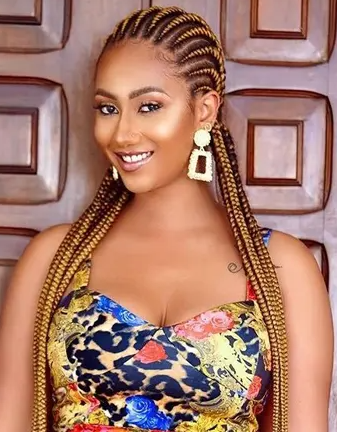
Updated: June 29, 2026 | From 3.4 million Instagram followers to a US federal prison. From deportation back to Ghana to appearing on America’s “Worst of the Worst” criminal aliens list — while posting “Thicc and Bougie” videos on Facebook. This is the most extraordinary celebrity scandal in Ghana’s history.
She once had 3.4 million Instagram followers. A music career. A cosmetics line. A reputation as one of Ghana’s most glamorous and aspirational celebrities.
Today, Mona Faiz Montrage — known across West Africa and beyond as Hajia4Reall — is listed by the United States Department of Homeland Security as one of the “Worst of the Worst” criminal aliens in America. She is a convicted felon. A federal prisoner, released and deported. A woman at the centre of a courtroom custody battle that is exposing her lifestyle to a Ghanaian judge in real time.
And on June 4, 2026 — days after the ICE list went public — she posted a video of herself stepping into a luxury vehicle, captioned: “Thicc and bougie.”
This is the full story. Every chapter. Every twist. Every jaw-dropping detail.
Chapter 1: The Rise — Ghana’s Most Glamorous Influencer
To understand how far Hajia4Reall has fallen, you need to understand how high she climbed.
Born Mona Faiz Montrage in Accra, Ghana, she built her public profile through Instagram — a carefully curated world of designer clothes, luxury cars, exotic holidays, and the kind of aspirational lifestyle that made her one of the most followed accounts in the entire country. At her peak, she had approximately 3.4 million Instagram followers and was ranked among the top 10 most-followed profiles in Ghana.
She was not just an influencer. In November 2020, she launched a music career with her debut single Badder Than, followed by her 2021 EP Here To Stay, which earned her a nomination for Best Music Video at the 2022 Vodafone Ghana Music Awards. She started a cosmetics line — 4Reall Beauty Cosmetics. She appeared on red carpets. She was photographed at the most exclusive events in Accra.
The story she told the world was one of success, ambition, and self-made glamour.
But behind the Instagram posts, a very different story was taking shape. One that had been building since 2013.
Chapter 2: The Crime — A $2 Million Romance Scam Empire
Between 2013 and 2019, Hajia4Reall was part of what US prosecutors described as a sophisticated West African criminal enterprise — known internally as “The Enterprise” — that systematically targeted lonely, vulnerable, older Americans online.
The method was calculated and cruel. Members of The Enterprise would contact victims through emails, text messages, and social media, creating fake identities and pretending to be in romantic relationships with the targets. Once emotional trust was established, the requests for money began — and they did not stop.
The false pretenses used to extract money were elaborate:
- Payments to help transport gold from overseas to the United States
- Payments to resolve a fake FBI unemployment investigation
- Money to assist a fake United States Army officer in receiving funds stranded in Afghanistan
In one case that appeared in US court documents, Hajia4Reall used her real name and identity. She spoke to the victim several times by phone. She sent them a tribal marriage certificate — a fake document purporting to show she and the victim had been married in Ghana. Then she convinced the victim to send her approximately $89,000 across 82 wire transfers — all supposedly to help with costs associated with her father’s farm in Ghana.
In total, prosecutors established that she controlled bank accounts that received more than $2 million in fraudulently obtained funds.
She received money not only from her own direct victims but also from other scammers within The Enterprise who funneled their proceeds through her accounts. Prosecutors said she directly benefited from the scam, receiving money from around 40 victims.
The scale of the operation — six years, dozens of victims, millions of dollars — was not the work of an amateur. It was systematic, organised, and deeply premeditated.
Chapter 3: The Arrest — Caught in London, Sent to New York
For years, Hajia4Reall continued her public life in Ghana without consequence. The Instagram posts continued. The music career launched. The cosmetics line expanded.
Then, on November 10, 2022, she was arrested in the United Kingdom.
The arrest sent shockwaves through Ghana. A Ghanaian celebrity — one of the country’s most recognisable faces — had been detained by British authorities at the request of the United States. The case, filed in the Southern District of New York, charged her with six federal counts:
- One count of conspiracy to commit wire fraud
- One count of wire fraud
- One count of money laundering conspiracy
- One count of money laundering
- One count of conspiracy to receive stolen money
- One count of receipt of stolen money
Each wire fraud and money laundering count carried a maximum sentence of 20 years. The conspiracy charges carried up to five and ten years respectively.
She was extradited to the United States on May 12, 2023. Moving her from the UK to the US across two continents underscored the seriousness of the charges against her.
At Manhattan Federal Court, she appeared before the judge and pleaded not guilty. Her attorney, Adam Cortez, argued that of six alleged victims, only two dealt with a woman, and only one claimed to have dealt directly with Montrage herself. She was released on a $500,000 bond, ordered to remain at her aunt’s residence in New Jersey, and fitted with an ankle monitor restricting her movements to parts of New York and New Jersey.
Chapter 4: The Guilty Plea — And the Names She Gave Up
On February 21, 2024, Hajia4Reall changed her plea. She pleaded guilty to one count of conspiracy to receive stolen money — a strategic plea deal that dramatically reduced her exposure from a potential 20-year sentence.
As part of the plea agreement, she agreed to forfeit over $2.1 million and make restitution in the same amount to US authorities.
But the most explosive revelation from the plea deal was what she gave the investigators in return for the reduced charge.
Reports from Ghanaian blogger Abena Moet — who has closely tracked the case — claimed that Hajia4Reall cooperated extensively with US authorities, naming her accomplices back home in Ghana. The informants she allegedly identified included:
- A popular Ghanaian musician
- A famous Ghanaian actor
- A big Ghanaian politician
- A very prominent businessman in the hospitality industry
None of the four names have been publicly confirmed. All remain confidential as part of the ongoing US investigation. But the revelation that a high-profile entertainer may have cooperated with American federal investigators against some of Ghana’s most prominent figures sent a chill through Accra’s elite circles.
Ghana, according to multiple reports, was about to “shake.” It still hasn’t fully stopped.
Chapter 5: Sentencing, Prison, and Deportation
On June 28, 2024, US District Judge J. Paul Oetken delivered the sentence. Hajia4Reall received:
- One year and one day in federal prison
- Three years of supervised release following incarceration
- An order to forfeit $216,475
- An order to pay $1,387,458 in restitution to her 40 victims
She voluntarily surrendered to US authorities on July 29, 2024, and was detained at the Federal Detention Center in Philadelphia, Pennsylvania.
On May 22, 2025 — having served her sentence — she walked out of federal prison. As part of a self-deportation agreement proposed by her legal team during sentencing, she returned to Ghana shortly after her release, under the supervision of US government agencies who would continue monitoring her activities for the subsequent three years.
She came home. Ghana watched. And then the next chapter began.
Chapter 6: America’s “Worst of the Worst” List — June 2026
Just when it seemed the dust might be settling, the US Department of Homeland Security released a new publication as part of President Donald Trump’s administration’s aggressive immigration enforcement drive — and Hajia4Reall’s name and photograph appeared in it.
The list, published by the DHS, features 355 West African immigrants who have either been deported or are currently facing deportation proceedings, with about 30 of them identified as Ghanaians. The DHS described those included as the most dangerous criminal aliens arrested by ICE.
The official DHS statement accompanying the list read: “The U.S. Department of Homeland Security is highlighting the worst of the worst criminal aliens arrested by the U.S. Immigration and Customs Enforcement. Under DHS leadership, the hardworking men and women of DHS and ICE are fulfilling President Trump’s promise and carrying out mass deportations — starting with the worst of the worst.”
Hajia4Reall features prominently on the US ICE’s most dangerous criminal aliens list for 2026, named for fraud committed in Philadelphia, Pennsylvania.
For a woman who had built her entire identity around aspiration, luxury, and public admiration — being listed by the most powerful government on earth as one of the “worst of the worst” criminal aliens was a designation that carried enormous weight.
Chapter 7: Her Response — “Thicc and Bougie”
Hajia4Reall’s response to the ICE blacklisting was pure, unapologetic Hajia4Reall.
On June 4, 2026, she was spotted flaunting her features while stepping into a luxury vehicle in a Facebook video she posted, captioned simply: “Thicc and boujie.”
In a separate TikTok video, she was filmed singing along to Ayra Starr’s Rush — the lyrics functioning as a pointed message to critics: “Me no get the time for the hate and the bad energy.”
In an Instagram post, she said she was not ashamed of her past as an ex-convict, describing her journey as part of God’s plan and brushing aside attempts to humiliate her.
The reaction online was as divided as everything else in her story. Supporters praised her confidence and resilience. Critics accused her of showing no remorse for the victims — older, vulnerable Americans — whose lives her fraud operation had financially and emotionally devastated.
Chapter 8: The Accra Courtroom — A Mother’s Fight to Keep Her Children Safe
If the ICE blacklisting was not enough, a parallel drama was unfolding simultaneously in an Accra courtroom — one that placed Hajia4Reall’s lifestyle under direct judicial scrutiny.
Since returning to Ghana, Hajia4Reall had become romantically linked to Richard Nii Armah Quaye — known publicly as RNAQ — a wealthy Ghanaian businessman embroiled in a high-profile divorce from his wife of 16 years, Joana Quaye. On January 20, 2026, the Accra High Court delivered a verdict in the divorce battle, awarding Joana Quaye a lump sum of GH₵300,000, a one-third share of their house at Dansoman, two Jaguar FX cars, and GH₵5,000 monthly upkeep for the three children — despite her request for GH₵50 million, which she argued reflected her contributions to the business they built together over 16 years.
The case took a dramatic new turn when it emerged that RNAQ, during his custody visits with the children, was frequently unavailable — leaving the children in the care of Hajia4Reall.
Hajia4Reall was seen taking RNAQ’s children aboard his private jet for a fun trip, along with her own daughter Naila, with the group dressed in traditional attire as they walked towards the aircraft.
Joana’s lawyers moved swiftly. On June 2, 2026, proceedings in the Accra Family Court centred on an application asking the court to restrict access by Hajia4Reall to the couple’s children, with the petitioner attaching video evidence and relying on material relating to Hajia4Reall’s previous incarceration, arguing that her association with the children may not be in their best interests.
Joana expressed concern over an incident involving one of her daughters at an event where Hajia4Reall was present, alleging she witnessed her daughter dancing in a manner she considered inappropriate while under Hajia4Reall’s supervision.
The trial judge adjourned the case to June 26, 2026, to review the video evidence and decide on the next course of action.
The court hearing on June 26 — the same week as the ICE blacklisting going global — means Hajia4Reall is simultaneously dealing with American federal scrutiny and Ghanaian judicial proceedings. Two countries. Two legal systems. One woman at the centre of all of it.
Chapter 9: The Victims the World Forgot
In every viral post, every courtroom update, every “bougie” video — it is easy to forget that this story has real human casualties who have never fully recovered.
The 40 victims of Hajia4Reall’s fraud operation were not abstract figures. They were real people — predominantly older, single Americans — who were manipulated into believing they were in genuine romantic relationships. They were deceived, groomed over months and years, and systematically emptied of their savings.
One victim sent 82 wire transfers totalling $89,000 — money they believed was helping their “wife’s” father’s farm in Ghana. Another lost savings to a fake FBI investigation. Another gave everything they had to help a “US Army officer” stranded in Afghanistan.
The US attorney who prosecuted the case said clearly: “These scams can be both financially and emotionally devastating for vulnerable victims.”
Hajia4Reall has been ordered to pay $1,387,458 in restitution to those 40 victims. She remains under US supervised release monitoring until 2028.
Chapter 10: Where She Stands Now
As of June 29, 2026, here is where Hajia4Reall’s situation stands:
- ✅ Released from US federal prison — May 22, 2025
- ✅ Deported to Ghana — May/June 2025
- ⚠️ Named on DHS/ICE “Worst of the Worst” criminal aliens list — June 2026
- ⚠️ Subject to Ghanaian court proceedings over access to RNAQ’s children — next hearing adjourned from June 26, 2026
- ⚠️ Under US supervised release monitoring — until 2028
- 💰 Owes $1,387,458 in restitution to 40 victims
- 📱 Still active on social media — posting daily, living what appears to be a luxury lifestyle
Whether Ghana’s courts will restrict her access to RNAQ’s children, whether the US monitoring of her activities will result in further consequences, and whether the names she allegedly gave to US investigators will ever become public — all of that remains to be seen.
What is certain is this: the story of Hajia4Reall is nowhere close to over.
The Bigger Picture: Fame, Fraud and Moral Accountability in the Social Media Age
The Hajia4Reall story is more than a celebrity scandal. It is a mirror held up to the age of social media — where carefully constructed images of wealth and success can mask criminal empires; where millions of followers provide social proof for lifestyles built on other people’s suffering; and where the line between influencer and fraudster can be extraordinarily thin.
Ghana has grappled with the phenomenon locally known as “sakawa” — internet fraud — for years. It exists across West Africa. It ruins lives — both those of the victims who lose their savings, and those of the perpetrators who eventually face the full weight of international law enforcement.
Hajia4Reall’s story is the most high-profile case yet of a Ghanaian celebrity being caught in that web. And it has sparked a national conversation about accountability, aspiration, and what it truly means to be successful.
The luxury cars were real. The Instagram followers were real. The federal conviction was real.
The farm in Ghana — the one she told the victim their money was going to — was never real at all.
Sources: US Department of Justice (SDNY), US Department of Homeland Security, YEN.com.gh, Legit.ng, Pulse Ghana, Graphic Online, Citi Newsroom, Daily Guide Network, GhanaWeb, Africanews, Covebeat, Sportskeeda, Modern Ghana, Law Platform Online