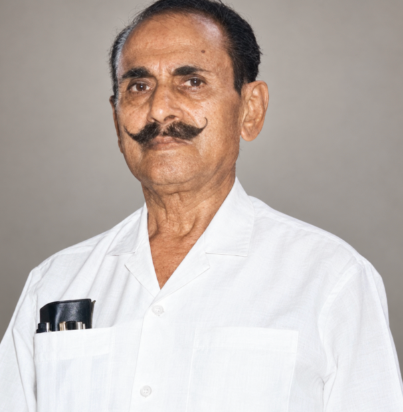
The Spice Merchant Who Bet on the World
Long before digital lotteries, online sports betting apps, or high-stakes casinos transformed global gambling, a single migrant from Kutch changed the financial subculture of Mumbai forever. His name was Kalyanji Gangadhar Gala, though the world would come to know him simply as Kalyanji Bhagat.
Arriving in Bombay during the hungry years of the Second World War with little more than a pocketful of coins and an unyielding work ethic, Bhagat transformed a simple neighborhood numbers game into a multi-crore daily betting network that captivated millions. From the smoke-filled chawls of Worli to the sprawling textile mills of Central Mumbai, his name became synonymous with fortune, risk, and radical opportunity.
This is the definitive, unvarnished history of Kalyanji Bhagat: his humble beginnings as a hawker, his ingenious creation of Worli Matka, his legendary rivalry with Ratan Khatri, and the devastating family tragedy that brought his syndicate crashing down.
–Image of: –Kalyanji Bhagat Editorial Art
From Drought-Stricken Kutch to the Chawls of Worli
To understand Kalyanji Bhagat, one must trace his roots back to Ratadiya, a small, dust-swept village in the Ganesh Wala region of Kutch, Gujarat. Born into a modest agricultural family named Gala, young Kalyanji grew up in an environment where survival depended on the unpredictable monsoons.
The title “Bhagat”—a derivative of bhakt, meaning a devout worshipper—was not an official surname. It was an honorific title bestowed upon his deeply religious family by the King of Kutch in recognition of their pious lifestyle and service to the local community. While the King offered spiritual recognition, Kutch offered little economic relief. Recurring droughts and devastating crop failures forced thousands of Kutchi families into mass migration during the early 1940s.
In 1941, a young Kalyanji packed his belongings and boarded a train bound for Bombay, the thriving commercial capital of British India. Like thousands of Kutchi migrants before him, he settled in the dense, working-class neighborhood of Worli, taking up residence in a modest room within a BBD Chawl.
Bhagat was a man of quiet determination and immense practical intelligence. He took on whatever honest work he could find, starting as a masala feriwala—a street hawker carrying heavy sacks of freshly ground spices through the narrow gullies of South and Central Mumbai. His relentless hustle eventually earned him a position managing a local kirana (grocery) shop in Worli. Yet, as he spent his days measuring pulses and spices, Bhagat observed something far more valuable: the insatiable appetite of Bombay’s working class for a chance at financial freedom.
The Cotton Ticker Era and the Birth of Ankada Jugar
In the mid-20th century, Bombay was the undisputed cotton capital of Asia. The heart of this industrial boom lay in Girangaon—the “City of Mills”—a vast swath of Central Mumbai encompassing Parel, Lalbaug, Worli, Sewri, and Dadar, where over 130 textile mills operated around the clock. Hundreds of thousands of mill hands, dock workers, coolies, and handcart pullers labored long hours in punishing heat for modest monthly wages.
During the 1950s, an informal gambling tradition known as Ankada Jugar (“figures gambling”) took root around the Bombay Cotton Exchange in Sewri and Kalba. The premise was disarmingly simple: punters placed bets on the opening and closing prices of raw cotton transmitted via teleprinter from the New York Cotton Exchange (NYCE) to Bombay.
Local bookies set up makeshift stalls outside mill gates and tea shops. Workers would gather during shift changes, laying down small bets on the last digits of the official cotton rates. Kalyanji Bhagat, drawing on his natural talent for numbers and his deep network among local Kirana buyers, began accepting small wagers on behalf of cotton bookies.
Unlike established, high-stakes bookmakers who catered to wealthy merchants, Bhagat opened his doors to everyone. He accepted bets as tiny as a single paisa. A mill hand earning two rupees a day could risk four annas and potentially win enough to send money back to his village in Maharashtra or Gujarat. Bhagat quickly earned a reputation for scrupulous honesty; if a worker won, Bhagat paid out every pie immediately without hesitation.
The 1961 Crisis and the April 2, 1962 Innovation
The golden era of cotton rate betting came to an abrupt halt in 1961. Facing pressure from regulatory authorities and international financial institutions, the New York Cotton Exchange permanently banned the transmission of opening and closing cotton rates to overseas markets.
Overnight, the entire infrastructure of Ankada Jugar collapsed. Thousands of small-time bookmakers faced financial ruin, and the mill workers of Bombay lost their favorite pastime.
Where others saw catastrophe, Kalyanji Bhagat saw an unprecedented opportunity. He realized that the punters did not care about cotton itself; they cared about the thrill of the draw, the transparency of the system, and the promise of a fair payout. If the New York Cotton Exchange would no longer provide random numbers, Bhagat decided he would generate them himself.
On April 2, 1962, in the open courtyard of his building, Vinod Mahal, in Worli, Kalyanji Bhagat conducted the first official draw of what he named Worli Matka.
–Image of: –Satta Matka History Art
How the Original Worli Matka Worked
Standing before a crowd of curious onlookers, mill workers, and local shopkeepers, Bhagat declared: “I am a jyotish [astrologer], not a gambler.”
He introduced a system built around Indian astrology and simple playing cards:
- The Card Deck: Bhagat used a standard pack of playing cards but removed the Knaves (Jacks).
- Astrological Numerology: The Queen represented the number 11, and the King represented the number 12, corresponding directly to the 12 rashis (zodiac signs) of Indian astrology.
- The Earthen Pot: To select numbers randomly, paper slips inscribed with digits were placed inside a large, traditional earthen pitcher—known in Hindi and Marathi as a matka.
- The Community Draw: A neutral bystander or a child from the crowd would be invited to draw a slip from the matka in full public view, ensuring complete transparency.
The game was an instant sensation. By replacing inaccessible foreign cotton tickers with a visible, community-focused drawing mechanism, Bhagat created a system that felt open, trustworthy, and deeply personal.
The Mechanics of the Matka Draw
As the popularity of Satta Matka exploded across Maharashtra, the mathematical structure of the game was refined into the classic format that persists today.
To play, a bettor selects three numbers between 0 and 9. For example, if a player chooses 1, 4, and 7:
- The First Addition: The three digits are added together: $1 + 4 + 7 = 12$.
- The Single Digit: The last digit of the total sum is retained. In this case, the last digit of 12 is 2.
- The First Set (Open): The complete first result is recorded as 1, 4, 7 * 2.
- The Second Addition: A second set of three numbers is drawn independently, say 2, 3, and 5. Added together ($2 + 3 + 5 = 10$), the last digit is 0.
- The Second Set (Close): The second result is recorded as 2, 3, 5 * 0.
- The Final Result (Jodi): The two single digits are combined to form the winning pair or Jodi: 20.
[ First Draw: 1, 4, 7 ]  ---> Sum = 12 ---> Last Digit = 2  (OPEN)
[ Second Draw: 2, 3, 5 ] ---> Sum = 10 ---> Last Digit = 0  (CLOSE)

FINAL WINNING JODI = 20
Payout Structure
The genius of Bhagat’s mathematical structure lay in its massive payout multiples balanced against astronomical odds:
- Single Digit (Ank): Betting on a single digit yielding a payout of 9:1.
- Jodi (Pair): Betting on the two-digit combination yielding a payout of 90:1.
- Patti / Pana (Three-Digit Combination): Betting on the exact three-digit set yielding payouts ranging from 140:1 to 900:1 depending on whether the digits were single, double, or triple combinations.
Because bookmakers retained a commission on all pools, the house always held a built-in mathematical edge, while players were lured by the life-changing prospect of turning a 10-rupee note into 9,000 rupees overnight.
The Clash of Kings: Kalyanji Bhagat vs. Ratan Khatri
By the mid-1960s, Matka was generating tens of lakhs of rupees daily. Such immense wealth naturally attracted competition. In 1964, a charismatic Sindhi migrant from Karachi named Ratan Khatrientered the arena, launching his own operation known as New Worli Matka (later renamed Main Ratan Matka).
The emergence of Khatri set off one of the most legendary rivalries in Indian business history—a clash of style, philosophy, and demographic appeal.
FeatureKalyanji Bhagat (Worli / Kalyan Matka)Ratan Khatri (Main Ratan Matka)Origin & BackgroundGujarati farmer & spice hawker from KutchSindhi migrant from Karachi, PakistanBase of OperationVinod Mahal compound, WorliDhanji Street, Zaveri BazaarOperational ScheduleOperating 7 days a weekOperating 5 days a week (Monday to Friday)Core AudienceWorking-class mill hands, coolies, driversUrban traders, businessmen, international bettorsDrawing MethodEarthen pot (matka) & picture cards3 playing cards drawn from a shuffled deckPublic ImageDevout, quiet, accessible patriarchFlamboyant, high-society “Matka King”
While Ratan Khatri cultivated a glamorous persona—frequenting racecourses, sponsoring movie stars, and expanding his syndicate across national and international borders—Kalyanji Bhagat remained rooted in his community. Bhagat dressed in a simple white cotton kurta, continued his daily religious prayers, and maintained his headquarters in Worli.
Kalyanji’s decision to keep Kalyan Matka operating seven days a week proved to be a masterstroke. For factory workers who labored six days a week, Sunday was their primary day for leisure and betting. While Khatri shut down on weekends, Bhagat’s booking dens did record turnover, solidifying Kalyan Matka as the undisputed household brand of the Indian working class.
The Golden Era and the Rise of Girangaon’s Underground Economy
Throughout the 1970s and 1980s, Satta Matka grew into a shadow economy that rivaled traditional banking in Central Mumbai. At its peak, the Matka ecosystem employed tens of thousands of people:
- Bookies & Sub-Bookies: Operating out of small wooden kiosks, pan shops, and back-alley offices outside every major textile factory.
- Runners & Writers: Young men who recorded bets on carbon-paper slips (pattis) and transported cash to regional collection centers.
- Declarers & Telephonists: Operators who relayed the winning numbers via landline networks across Maharashtra, Gujarat, Rajasthan, and Madhya Pradesh.
In industrial hubs like Parel and Dadar, the daily schedule of the neighborhood was governed by Matka timings. The “Open” result was declared in the afternoon just as morning factory shifts ended, while the “Close” result was announced late at night, bringing thousands of eager punters onto the streets to check the hand-written chalkboards outside betting shops.
Police Crackdowns and the Underworld Shadow
The sheer volume of cash circulating through the Matka network inevitably attracted the attention of law enforcement and Mumbai’s organized crime syndicates.
During the late 1980s and early 1990s, the Mumbai Crime Branch launched severe crackdowns under the Bombay Prohibition Act and the Maharashtra Prevention of Gambling Act. Police raided major betting dens, seized teleprinters, and arrested high-profile bookies.
Concurrently, the changing landscape of Mumbai’s underworld introduced dark pressures. Powerful crime syndicates—including figures linked to Haji Mastan, Varadarajan Mudaliar, and later Dawood Ibrahim’s D-Company—recognized Matka as a massive source of liquid cash. Underworld syndicates began demanding heavy extortion protection money (hafta) from top Matka operators.
To survive the heat, bookies began relocating their centralized drawing operations out of Mumbai, establishing hidden bases in rural Gujarat, Rajasthan, and the outskirts of Kalyan. Despite police pressure, the foundational brand built by Kalyanji Bhagat remained indestructible.
The Death of the Patriarch and the Succession Crisis
On September 22, 1994, Kalyanji Bhagat passed away at his home in Mumbai at an advanced age. His death marked the end of an era. The quiet, devout founder who had built a gambling empire from an earthen pot was buried with great reverence by the Kutchi community.
Following his death, control of the multi-crore Kalyan Matka empire passed to his son, Suresh Bhagat.
Suresh was vastly different from his father. While Kalyanji had operated with humility and community diplomacy, Suresh inherited a complex, high-stakes enterprise surrounded by predatory rivals, underworld extortionists, and internal family friction.
The Blood Money Betrayal: The 2008 Murder of Suresh Bhagat
By the mid-2000s, Kalyan Matka was generating an estimated 100 crore rupees annually. This staggering fortune ignited a lethal feud within Suresh Bhagat’s immediate family.
Suresh had married Jaya Chheda, a sharp, ambitious woman. Over time, the marriage fractured, leading to a bitter separation. Jaya, along with her son Hitesh Bhagat, sought total control of the lucrative Kalyan Matka brand and its vast real estate holdings.
When Suresh refused to hand over control of the business, Jaya and Hitesh hatched a cold-blooded conspiracy with members of Mumbai’s underworld.
The Alibaug Highway Hit
On June 13, 2008, Suresh Bhagat and six companions were returning to Mumbai after attending a routine court hearing in Alibaug. As their Mahindra Scorpio traveled along the lonely Alibaug-Pen road, a heavy industrial truck suddenly swerved across the center lane, ramming into Bhagat’s SUV at full speed.
Suresh Bhagat and five others inside the vehicle were crushed to death instantly.
Initial reports treated the incident as a tragic highway collision. However, suspicious financial transactions and intelligence gathered by the Mumbai Police Crime Branch—led by legendary investigators—quickly exposed a far darker truth.
The Forensic Breakthrough and Life Sentences
Crime Branch detectives discovered that the truck driver had been paid a massive cash bribe to execute a staged collision. The murder had been orchestrated by Jaya Chheda and Hitesh Bhagat, who had hired underworld gangster Suhas Roge and hitman Harish Mandvekar to execute the contract killing for a fee of 45 lakh rupees.
The motive was absolute greed: by eliminating Suresh, Jaya and Hitesh intended to usurp the entire Kalyan Matka empire and appropriate family trust properties, including a historic cowshed (Panjapur Trust) in Ratadiya, Kutch, established by Kalyanji Bhagat in 1947.
In October 2013, a Mumbai Sessions Court found Jaya Chheda, Hitesh Bhagat, Suhas Roge, Harish Mandvekar, Pravin Shetty, and Kiran Amle guilty of murder and criminal conspiracy under IPC Section 302 and Section 120B. All six were sentenced to life imprisonment.
The Family Feud Continues: Vinod Bhagat vs. Jaya Chheda
Even after the 2013 conviction, the dark saga of the Bhagat family refused to fade. In 2020, during the COVID-19 pandemic, Jaya Chheda was granted temporary bail. Upon her release, she visited Ratadiya village in Kutch and donated 51 lakh rupees to the Ratadia Panjapur Trust—the ancestral cow sanctuary founded by Kalyanji Bhagat in 1947—requesting that a memorial plaque be erected in honor of her slain husband, Suresh.
This gesture outraged Suresh’s elder brother, Vinod Bhagat, who served as a trustee. Vinod publicly objected, refusing to allow the name of the woman convicted of murdering his brother to be displayed on their father’s charitable foundation.
The dispute escalated into legal battles over properties in Kutch and Mumbai. In December 2020, Gujarat and Mumbai police uncovered a plot where Vinod Bhagat allegedly hired international hitmen to eliminate Jaya Chheda and her sister Asha, demonstrating that the toxic legacy of the Matka millions continued to haunt the family across generations.
The Modern Transformation: Satta Matka in the Digital Age
The conviction of Suresh Bhagat’s killers and the death of Ratan Khatri in May 2020 marked the end of physical Matka dens in Mumbai. The decline of the city’s textile mills in the 1990s had already dismantled the working-class community that originally sustained the game.
However, the legacy of Kalyanji Bhagat did not disappear; it merely migrated to cyberspace.
Today, digital platforms operating under names like Kalyan Chart, Kalyan Panel, and Satta King utilize mobile applications, online websites, and Telegram channels to display daily random number draws. While modern iterations rely on computer algorithms rather than paper slips drawn from an earthen pot, they still carry the name Kalyan—a permanent homage to the spice hawker from Kutch who started it all in a Worli courtyard over six decades ago.
The Legacy of Kalyanji Bhagat
Kalyanji Bhagat remains one of the most enigmatic figures in Indian socio-economic history. To legal authorities and moral reformers, he was the architect of an illegal gambling network that impoverished vulnerable families. To the working-class masses of 1960s industrial Bombay, he was a folk hero—a man of absolute word who offered a glimmer of hope in a city of grueling labor.
His journey from a penniless Kutchi migrant hawking spices to the undisputed patriarch of a multi-crore empire reflects the grit, ingenuity, and dark contradictions of Mumbai itself.