When Anti Consumerist Speeches Clash With Billion Dollar Beauty Empire Machines
The modern cultural arena is defined by a bizarre contradiction. Ultra wealthy celebrities, operating at the peak of global capitalist influence, increasingly attempt to speak the moral language of environmental restraint. In boardrooms, television studios, and high profile summit panels, A list founders frequently attempt to frame their multi million dollar brands as mindful, minimalist alternatives to mass market greed. Yet, when a public figure whose personal fortune and global fame rely on generating relentless viral consumer desire steps onto a stage and declares an aversion to overconsumption, the resulting explosion of public skepticism is swift and uncompromising.
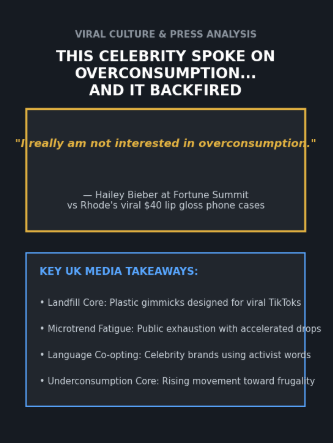
That explosive collision between corporate messaging and public fatigue reached a boiling point when fashion icon, model, and entrepreneur Hailey Bieber took the stage at the Fortune Most Powerful Women Summit. Speaking beside her brand co-founder Lauren Ratner, Bieber reflected on the rapid global rise of her skincare and cosmetics brand Rhode. In an attempt to explain the brand’s minimalist aesthetic and restrained product launch schedule, Bieber uttered a statement that immediately echoed across social media feeds and UK media commentary channels. She declared that she was really not interested in overconsumption.
To millions of digital observers, media analysts, and cultural commentators across the United Kingdom, the comment sounded like a profound disconnect from reality. Here was the chief creative officer of a beauty brand that had built its financial fortune on selling viral plastic accessories, single use skincare novelties, and collectible lip treatments in dozen color variations, claiming to stand against the very economic engine that propelled her enterprise to a one billion dollar acquisition valuation. Within hours of the interview clip circulating online, UK commentary creators, cultural critics, and consumer advocates seized upon the moment, transforming a routine corporate interview into a case study on celebrity hypocrisy, trend fatigue, and the co-opting of activist terminology.
The controversy exposed a much deeper rift in modern popular culture. For years, major corporate entities and celebrity founders have attempted to insulate themselves from public criticism by adopting the vocabulary of sustainability, minimalism, and conscious living. However, digital audiences in the United Kingdom and across the globe have grown increasingly fluent in identifying greenwashing and performative anti-consumerism. When a celebrity who travels via private jet and oversees the mass production of plastic phone attachments lectures the public on restraint, the backlash is no longer just a minor social media spat. It becomes a viral cultural reckoning that redefines how audiences evaluate celebrity integrity in the era of late stage capitalism.
The Fortune Most Powerful Women Summit Stage and the Statement That Sparked a Global Storm
The Fortune Most Powerful Women Summit is traditionally an prominent corporate venue designed for executives, industry leaders, and high net worth founders to discuss market expansion, brand vision, and leadership philosophy. When Hailey Bieber appeared on panel to discuss Rhode, the atmosphere was intended to highlight her transition from fashion model to formidable business executive. Having built Rhode from a modest three product line in two thousand twenty two into a dominant force in the global beauty market, Bieber stood as the visible face of a modern direct to consumer success story.
During the panel discussion, the interviewer raised questions regarding product catalog expansion, asking what items do not belong in the world of Rhode even if they would generate substantial sales. In response, Bieber attempted to articulate the core philosophy of her business model. She explained that the beauty industry is saturated with endless product drops and redundant launches, asserting that her vision for Rhode centered on creating a single, highly refined version of each essential product rather than flooding the market with unnecessary items.
It was during this explanation that Bieber made the remark that triggered the firestorm. She stated that she was really not interested in overconsumption, adding that she only wanted to produce items that she personally used and loved rather than releasing goods simply to drive up revenue metrics. She argued that Rhode was built on a quality over quantity philosophy, where a selected lineup of essential skincare items would prevent consumers from needing bloated vanity drawers filled with discarded cosmetics.
While the statement may have been intended as a defense of a lean product catalog, the phrasing proved fatal in the court of digital public opinion. Social media users instantly recognized the stark disparity between her words and the real world footprint of her corporate enterprise. Critics pointed out that while Rhode may maintain a smaller core skincare selection compared to legacy drug store brands, its entire marketing model relies heavily on artificial scarcity, limited edition color drops, hype generation, and the creation of impulse accessories designed specifically to go viral on short form video platforms.
Within twenty four hours, clips of the interview were reposted across TikTok, X, and YouTube, accumulating tens of millions of views. The comment was dissected not merely as an awkward interview moment, but as an emblem of executive tone deafness. Critics asked how the leader of a brand that manufactures plastic phone cases designed to hold single tubes of lip gloss could reasonably claim to be uninterested in excessive consumption. The statement was viewed not as a genuine commitment to environmental stewardship, but as an unearned attempt to wear the badge of anti-consumerist morality while running a relentless commercial hype machine.
The Rhode Marketing Machine: Lip Gloss Phone Cases, Pimple Patch Boxes, and Microtrend Gimmicks
To understand why Bieber’s comments triggered such widespread public outrage, one must examine the specific commercial mechanics that built Rhode into a powerhouse brand. From its inception, Rhode positioned itself at the epicenter of the clean girl aesthetic, a visual trend that gained massive momentum across digital platforms in the early two thousand twenties. Characterized by slicked back hair, glowing skin, neutral wardrobes, and effortless luxury, the clean girl aesthetic promised a refined, uncluttered lifestyle.
However, behind the calm, neutral color palette of Rhode’s packaging lay a sophisticated marketing apparatus engineered to maximize consumer purchasing frequency. The brand’s most famous product is not a hydrating serum or a face cream, but a grey silicone phone case featuring a built in groove designed specifically to hold a tube of Rhode peptide lip treatment. Sold for forty dollars, the item became an instant viral sensation, transforming every customer’s smartphone into a walking billboard for the company.
Media analysts and UK commentators quickly highlighted the inherent absurdity of the product. The lip gloss phone case was an object created to solve a problem that did not exist. Humans have utilized pockets, purses, coats, and backpacks to carry lip cosmetics for centuries. By molding a plastic telephone cover to fit one specific brand of lip treatment, Rhode created a single purpose accessory that becomes completely obsolete the moment a customer switches phone models or changes lip balm brands.
The phone case was merely the beginning of Rhode’s accessory ecosystem. The brand subsequently released specialized plastic cases designed to hold pimple patches, mini blush keychains that allow users to clip cosmetics to their belt loops, branded hair bands, and limited edition color drops where the exact same lip peptide formula was packaged in twelve different subtle tints. Each new drop was accompanied by intense countdown timers, exclusive launch events, and influencer gifting suites, creating an overwhelming atmosphere of consumer fear of missing out.
Furthermore, Rhode’s commitment to anti-overconsumption stood in sharp contrast to its packaging and fulfillment practices. The brand made extensive use of single use under eye patches, non-refillable heavy plastic containers, and massive promotional gifting boxes sent to hundreds of digital creators. When a company sends an influencer an oversized custom box containing four small skincare items encased in layers of custom molded plastic, foam, and shipping cardboard, claiming a corporate stance against excess becomes entirely untenable to an increasingly eco conscious audience.
Inside the UK Commentary Scene: Rachel Louise and the Dissection of Landfill Core
The response to Bieber’s summit remarks was nowhere more articulate or incisive than within the thriving UK commentary community on YouTube and digital media platforms. Over the past several years, independent British commentary channels have emerged as critical watchdogs of digital culture, dissecting influencer trends, corporate marketing tactics, and celebrity public relations blunders with sharp cultural analysis and humor.
Among the prominent figures addressing the scandal was British commentary creator Rachel Louise, whose video titled “This Celebrity Spoke on Overconsumption… and it BACKFIRED?” quickly became a central focal point for the discussion. Rachel Louise and her fellow UK commentators approached the incident not merely as gossipy drama, but as a symptom of a deeper structural disease within modern influencer commerce.
In her detailed analysis, Rachel Louise broke down the context of Bieber’s statements at the Fortune summit, pointing out the immediate hypocrisy of a founder claiming to disinterest herself from overconsumption while actively selling single use cosmetic accessories, plastic phone holders, and non-refillable packaging. However, the commentary went beyond surface level criticism to explore the psychological mechanisms of landfill core, a term coined by digital critics to describe cheap, trend driven plastic items designed specifically for viral social media moments rather than long term utility.
Landfill core represents the ultimate evolution of fast fashion principles applied to lifestyle accessories and cosmetics. These are objects designed to capture attention during a three week algorithm trend cycle on short form video apps. They are purchased compulsively by consumers seeking to feel connected to a viral aesthetic, used for a brief period in outfit videos or unboxing posts, and then discarded when the digital hype migrates to the next aesthetic trend.
UK commentators highlighted how Rhode’s product development perfectly mirrors the mechanics of landfill core. When a brand produces a mini blush keychain or a dedicated pimple patch case, it is not solving a genuine human need. It is manufacturing a novelty item whose primary function is to serve as content for social media promotion. Once the viral trend subsides, these plastic objects inevitably find their way into drawers, trash bins, and ultimately oceanic landfills.
By analyzing Bieber’s statements through the lens of UK commentary culture, creators like Rachel Louise provided audiences with a vocabulary to challenge celebrity narratives. They demonstrated that corporate claims of conscious curation are often nothing more than aesthetic camouflage designed to mask high volume consumer exploitation behind a serene, neutral toned facade.
The Anatomy of Modern Overconsumption: Unnecessary Objects Versus Excessive Possessions
One of the most valuable contributions arising from the UK commentary surrounding the Bieber row was a clear conceptual distinction between two fundamentally different forms of overconsumption. To the average consumer, overconsumption is often understood simply as owning a massive quantity of physical items, such as giant clothing hauls, overflowing shoe closets, or sprawling beauty collections documented in viral unboxing videos.
However, British media analysts pointed out that true commercial overconsumption operates on two distinct levels. The first level is consumer driven quantitative excess, where an individual purchases far more goods than they could ever reasonably use or wear. The second, and arguably more destructive level, is brand driven qualitative absurdity, where corporate manufacturers create entire product categories of entirely unnecessary objects that exist solely to extract profit from manufactured microtrends.
When Hailey Bieber asserted that Rhode was not interested in overconsumption because the brand maintained a smaller product range, she was relying entirely on the first definition. From an executive perspective, because Rhode was not releasing fifty different eyeshadow palettes or thirty foundation shades like legacy drugstore conglomerates, the brand could claim to be environmentally restrained.
Yet, as UK commentators brilliantly illustrated, Rhode was actively pioneering the second, more insidious form of overconsumption. Creating a plastic shell for a telephone that only accepts a single proprietary lip balm tube is an act of extreme commercial excess. The product does not add meaningful value to human existence, nor does it improve the quality of skincare application. It is an unnecessary object born purely out of corporate desire to generate algorithmic noise and impulse purchasing.
This distinction is crucial for understanding why digital audiences reacted with such intense hostility. Consumers recognized that while an individual might only own one lip gloss phone case, the creation and mass production of hundreds of thousands of those plastic cases by a corporate entity constitutes severe environmental degradation. When brands manufacture gimmicks that are inherently destined for early disposal, they are actively driving global resource depletion regardless of how small their core skincare catalog appears on paper.
Furthermore, UK critics highlighted the hypocrisy of corporate entities shifting the moral burden of overconsumption onto individual citizens. While everyday consumers are urged to recycle household plastics, carry reusable water bottles, and feel guilty about purchasing occasional fashion items, billionaire celebrities and multinational corporations continue to manufacture millions of single use plastic items, charter private aviation flights, and dispatch massive freight shipments of promotional material across the globe.
The Co-opting of Online Anti-Capitalist Language by Celebrity Founders
A recurring theme within British cultural commentary on the Bieber controversy was the systematic co-opting of activist terminology by elite celebrity entrepreneurs. Over the past decade, terms like sustainability, conscious consumption, ethical sourcing, and underconsumption have migrated from grassroots environmental movements into corporate marketing strategy decks.
Celebrity founders and public relations strategists quickly realized that modern Gen Z and millennial consumers possess a deep skepticism toward traditional aggressive salesmanship. To appeal to an audience concerned about climate change, economic inequality, and environmental collapse, brands had to adopt the language of social responsibility. Commercial campaigns were reframed as wellness movements, and product drops were described as thoughtful lifestyle selected collections.
In the case of Hailey Bieber and Rhode, the use of the phrase not interested in overconsumption was a textbook example of this linguistic hijacking. By using a phrase popular among anti-capitalist critics and environmental advocates, Bieber attempted to position her commercial enterprise as an ally to the conscious consumer movement. It was an attempt to signal that buying Rhode was not an act of blind consumerism, but a deliberate choice to support a mindful, restrained approach to beauty.
UK commentary creators fiercely dismantled this tactic, pointing out that an enterprise capitalized at one billion dollars and owned by a major global cosmetics corporation cannot, by definition, be anti-consumerist. The primary fiduciary duty of any major corporate entity is to drive continuous quarterly revenue growth and expand market share. Claiming that a hyper growth beauty venture is disinterested in consumption is fundamentally paradoxical.
This linguistic co-opting represents a dangerous trend in modern media dynamics. When ultra wealthy public figures appropriate the terminology of environmental critique to sell commercial goods, they dilute the meaning of those terms and neutralize genuine activist movements. Anti-overconsumption is not a visual aesthetic characterized by grey packaging and sleek hair clips. It is an active economic stance that demands reduced manufacturing volume, decreased resource extraction, and an end to continuous commercial expansion.
When UK commentators exposed this linguistic contradiction, they struck a responsive chord with a public exhausted by corporate gaslighting. Audiences refused to allow corporate executives to wear the vocabulary of environmental critique as a stylish fashion accessory while simultaneously profiting from the mass production of disposable plastic trend items.
PR Packages and Excessive Shipping: The Environmental Cost of Viral Influencer Unboxings
Beyond product design and executive rhetoric, the Bieber overconsumption controversy shone a harsh spotlight on the unseen logistical infrastructure of influencer marketing. For beauty and lifestyle brands operating in the modern digital economy, public relations gifting packages represent one of the most powerful tools for generating algorithmic visibility and social proof.
Rhode built its massive brand awareness largely through aggressive creator gifting campaigns. Hundreds of digital influencers across North America, Europe, and the United Kingdom regularly receive elaborate promotional shipments whenever Rhode launches a new product tint, blush shade, or seasonal accessory. These packages are not simple cardboard boxes containing a tube of cream. They are custom manufactured visual spectacles designed specifically to be filmed during unboxing videos.
UK environmental commentators and beauty industry critics have long criticized the immense waste generated by these promotional gifting suites. When Rhode launched its strawberry glaze lip peptide, selected influencers received giant custom acrylic strawberry containers, complete with specialized lighting, branded accessories, and multiple full size tubes of product. In other instances, creators were sent massive custom suitcases, insulated coolers, or electronic display stands containing tiny cosmetic items.
The environmental footprint of these gifting campaigns is staggering. Manufacturing custom acrylic, plastic, and foam packaging that is used once for a fifteen second video review and then discarded creates tonnes of plastic waste. Furthermore, sending full shade ranges of cosmetics to influencers who may only utilize a single shade matching their skin tone results in vast quantities of unused product heading directly into trash receptacles.
When Hailey Bieber publicly claimed that Rhode was uninvolved in overconsumption, digital creators who had received these massive promotional boxes immediately called out the hypocrisy. They pointed out that while ordinary retail customers might purchase a single lip treatment, Rhode’s corporate marketing strategy relied on shipping thousands of massive, over packaged gifting boxes around the globe to drive viral hype.
The critique highlighted the double standard inherent in influencer culture. While retail consumers are encouraged to view themselves as conscious buyers supporting a clean, minimalist brand, the behind the scenes commercial engine of that same brand operates on principles of extreme promotional extravagance and shipping waste.
The History of Celebrity Eco Hypocrisy in the United Kingdom Media
The public backlash against Hailey Bieber’s summit comments did not occur in a vacuum. In the United Kingdom, media outlets, cultural commentators, and the general public have maintained a long and contentious relationship with celebrity environmental advocacy. British tabloids and broadsheets alike have documented numerous instances where high profile figures delivered moral sermons on climate change and resource conservation while living lives of extreme personal luxury.
In UK media discourse, the phenomenon of celebrity eco hypocrisy has been documented across various prominent figures. Actress Emma Thompson drew widespread public criticism when she flew thousands of miles from Los Angeles to London to participate in Extinction Rebellion environmental protests, despite protest organizers urging the public to eliminate non-essential air travel. Similarly, members of the British royal family, including Prince Harry and Meghan Markle, faced intense tabloid headlines after publicly lecturing audiences on carbon footprints while frequently utilizing private luxury jets for personal holidays.
Other global icons frequently cited in British commentary include Hollywood actor Leonardo DiCaprio, who has delivered speeches at the United Nations regarding global warming while continuing to vacation on massive private mega yachts and charter private aviation flights. Former US Vice President Al Gore, producer of the climate documentary An Inconvenient Truth, was similarly scrutinized when reports revealed the massive energy consumption of his personal estate.
The UK public’s reaction to these incidents has bred a deep seated cynicism toward elite environmental lecturing. As British publications like The Boar have argued, when wealthy public figures use their platform to preach environmental restraint to working class citizens while refusing to alter their own opulent lifestyles, it causes immense damage to genuine ecological causes. It creates a bitter perception that climate responsibility is a burden intended solely for ordinary people, while elites enjoy total immunity.
When Hailey Bieber’s Fortune summit remarks reached United Kingdom commentary channels, they resonated within this established history of skepticism. To British audiences, Bieber’s claims were merely the latest chapter in a long running tradition of ultra wealthy celebrities attempting to adopt green credentials without sacrificing a single dollar of profit or a single luxury privilege.
The Psychology of Trend Cycles, Micro Trends, and Influencers as Horsemen of the Overconsumption Apocalypse
To fully grasp the broader cultural significance of the Bieber controversy, one must examine how social media algorithms have accelerated consumer purchasing behaviors to unprecedented speeds. In previous decades, fashion and beauty trends evolved across multi-year cycles governed by seasonal runway shows, magazine editors, and film releases. In the current digital environment, algorithms on TikTok and Instagram generate microtrends that emerge, peak, and die within weeks.
From tomato girl summer and mob wife aesthetic to clean girl minimalism and office siren, these algorithmic microtrends require consumers to constantly purchase new wardrobes, cosmetic palettes, and lifestyle accessories to remain culturally relevant. Each microtrend comes with its own selected checklist of physical goods that creators insist are mandatory for achieving the look.
In her UK commentary analysis, Rachel Louise memorably described digital influencers as the horsemen of the overconsumption apocalypse. This dramatic phrasing encapsulates the pivotal role that digital creators play in driving hyper-consumerism. Influencers serve as the commercial liaison between corporate manufacturing hubs and impressionable digital audiences. By framing commercial products as essential components of personal identity, self care, and social belonging, influencers transform voluntary shopping into a psychological imperative.
The business model of influencer commerce thrives on promoting two complementary forms of consumer behavior: purchasing vast quantities of goods and acquiring single use novelty items. Creators film weekly shopping hauls, Amazon must haves videos, and morning routine reels that display vanity tables overflowing with dozens of identical serums and lip balms. Concurrently, they promote viral gimmick items like lip gloss phone cases, ice rollers, and specialized mini totes.
The psychological impact on consumers, particularly younger audiences, is profound. Continuous exposure to algorithmically selected abundance creates a distorted perception of normal consumption. Viewers begin to view owning forty different lip treatments or purchasing plastic phone attachments as standard lifestyle behavior rather than extreme commercial excess.
When Bieber claimed her brand was uninvolved in this cycle, she was attempting to deny Rhode’s central role as a primary driver of modern microtrend culture. Rhode did not merely participate in the clean girl movement; it aggressively monetized that movement by transforming minimalist aesthetics into a series of highly marketable, collectible plastic objects. UK commentators exposed this strategy, reminding viewers that aesthetic minimalism when weaponized by corporate marketing is simply consumerism in a different shade of grey.
The Consumer Backlash and the Rise of Underconsumption Core on Social Platforms
The intense public reaction to Hailey Bieber’s summit remarks coincided with a major cultural shift taking place across social media platforms throughout two thousand twenty four and two thousand twenty five. After years of watching influencers display massive shopping hauls, pristine beauty closets, and endless product drops, digital audiences began experiencing severe consumer fatigue.
This fatigue sparked the emergence of digital counter trends known as underconsumption core, de-influencing, and project pan. Originating as a spontaneous pushback against hyper-consumerism, creators participating in underconsumption core posted videos displaying worn shoes, panned makeup palettes where the metal bottom was visible, minimalist wardrobes, and multi purpose household goods that had been used for years.
Unlike the polished, aspirational minimalism of the clean girl aesthetic, underconsumption core celebrated authentic frugality and resourcefulness. It urged viewers to use up every drop of cosmetic products before purchasing replacements, resist algorithmic impulse buying, and reject manufactured microtrend novelties. The movement gained massive traction in the United Kingdom, where rising living costs, inflation, and economic pressures made excessive influencer spending seem increasingly out of touch with everyday reality.
It was within this cultural climate that Bieber’s anti-overconsumption statement landed. To an audience actively trying to embrace underconsumption principles, hearing a billionaire fashion icon claim that a lip gloss phone case was part of a mindful lifestyle felt absurd. Viewers recognized that Rhode’s marketing model was the exact antithesis of underconsumption core.
UK media analysts noted that the rise of underconsumption core represents a growing resistance to corporate influence. Consumers are increasingly sharing strategies for repairing clothing, repurposing container jars, and recognizing psychological sales triggers used by direct to consumer brands. The backlash against Bieber served as a clear warning to corporate executives: modern audiences will no longer tolerate the romanticization of plastic gimmicks disguised as conscious lifestyle choices.
The Billion Dollar Acquisition by e.l.f. Beauty and the Reality of Mass Scale Production
To fully evaluate the corporate realities behind Rhode, one must look beyond social media marketing to the structural financial backing of the enterprise. In a landmark corporate transaction that sent shockwaves through the cosmetics industry, Rhode was acquired by e.l.f. Beauty in a deal valued at over one billion dollars, with Hailey Bieber continuing to serve as Chief Creative Officer and head of product innovation.
The acquisition marked a pivotal moment in the brand’s evolution, transitioning Rhode from an independent celebrity startup into a core asset of one of the largest budget cosmetics conglomerates in North America. e.l.f. Beauty is renowned throughout the retail industry for its rapid product development cycles, high volume global manufacturing, and aggressive mass market distribution across major retail chains.
This corporate union highlights the glaring contradiction in Bieber’s Fortune summit statements. While Bieber was on stage describing Rhode as a restrained brand uninterested in excessive manufacturing, her company was actively integrating its operations into a multinational parent entity that thrives on high volume, fast moving consumer beauty goods.
Mass scale production under a major beauty conglomerate requires continuous output, expanded global retail presence, and massive supply chain logistics. Achieving the financial returns necessary to justify a one billion dollar valuation is impossible through minimalist restraint alone. It demands relentless consumer acquisition, expanded product categories, and continuous global shipping operations.
UK financial and media commentators emphasized that Bieber’s role as Chief Creative Officer under e.l.f. Beauty firmly aligns her with global commercial expansion. Claiming an aversion to overconsumption while serving as the creative architect for a brand backed by a billion dollar beauty conglomerate demonstrates a fundamental refusal to acknowledge the basic economic realities of mass market manufacturing.
Comprehensive Profiles of Key Figures Shaping the Overconsumption Debates
Understanding the nuances of the overconsumption row requires examining the background, commercial interests, and media platforms of the primary individuals involved in the debate.
Hailey Bieber, born Hailey Rhode Baldwin, is an American fashion model, media personality, and entrepreneur. Rising to global prominence through high fashion modeling campaigns and her marriage to pop icon Justin Bieber, she built a massive digital following of over fifty million followers. In two thousand twenty two, she founded Rhode, positioning herself as Chief Creative Officer and developing products that defined the clean girl aesthetic. Her position as an industry trendsetter gives her immense commercial power, making her public statements regarding consumer ethics subject to intense global scrutiny.
Rachel Louise is a prominent British media commentator, YouTube creator, and cultural analyst specializing in dissecting digital trends, influencer culture, and consumer ethics. Through her video essays and detailed media commentary, she has established a reputation for dismantling corporate greenwashing, analyzing microtrend cycles, and providing educational insights into the environmental costs of influencer marketing. Her commentary on Bieber’s Fortune summit remarks provided a structured framework for British and international audiences to critique corporate spin.
Lauren Ratner is the co-founder and Chief Marketing Officer of Rhode, working alongside Hailey Bieber to build the brand’s direct to consumer strategy. With an extensive background in fashion marketing and brand development, Ratner was instrumental in engineering Rhode’s viral marketing campaigns, including the lip gloss phone case and scarcity drop schedules. Her presence on the Fortune summit panel highlighted the strategic corporate decision making behind Rhode’s brand positioning.
Sean Evans is an American digital host and creator best known for hosting Hot Ones, the viral interview show where celebrity guests answer in depth questions while consuming increasingly spicy chicken wings. Evans is frequently cited by UK creators like Rachel Louise and Brittany Broski as a prime example of an innovative interviewer who transformed traditional press junkets into authentic, entertainment driven media experiences, setting a high benchmark for digital media production.
Greta Thunberg is a world renowned Swedish environmental activist whose global climate strikes inspired millions of young people across the United Kingdom and Europe. Her uncompromising stance against corporate delay and greenwashing has made her a central figure in modern environmental discourse, though her high profile media appearances have occasionally drawn scrutiny regarding the complex logistics of carbon neutral international travel.
Fast Fashion Alignment and the Environmental Cost of Microtrend Aesthetics
The intersection between viral beauty marketing and the fast fashion industry represents one of the most ecologically destructive forces in contemporary consumer culture. While beauty brands like Rhode present themselves as high end, minimalist skincare houses, their product release strategies are deeply aligned with the fast fashion business model pioneered by ultra fast fashion retail titans.
Fast fashion relies on compressing the production cycle from months to days, churning out thousands of cheap garments designed to capitalize on fleeting social media moments. In the cosmetics sector, this strategy manifests as microtrend drops where accessories, limited color editions, and novelty packaging are manufactured rapidly to coincide with viral digital aesthetics.
UK environmental organizations have repeatedly documented the severe ecological consequences of this hyper accelerated manufacturing cycle. Millions of metric tonnes of synthetic plastics, non-recyclable silicone, and chemical dyes are utilized to produce novelty lifestyle goods that possess a functional lifespan measured in weeks. When a trend shifts from clean girl to another viral look, the associated plastic phone covers, color tinted lip containers, and promotional vanity accessories are rendered culturally obsolete.
In British media commentary, critics noted that Rhode’s commercial strategy actively reinforces this disposable fast fashion mindset. By encouraging consumers to treat cosmetic packaging as a seasonal wardrobe accessory, changing phone covers whenever a new lip tint shade is released, Rhode transforms functional personal care items into disposable style novelties.
The environmental footprint extends far beyond retail waste. The extraction of petrochemicals required to produce synthetic silicone phone cases, the global shipping emissions generated by air freighting individual parcel orders directly to consumers, and the municipal waste management burdens placed on local councils across the United Kingdom all contribute to environmental degradation.
When Bieber delivered her anti-overconsumption remarks, UK environmental analysts highlighted this systemic ecological cost. They argued that a company cannot align its commercial strategy with fast fashion mechanics while claiming environmental innocence. True sustainability requires slowing down manufacturing velocity, designing durable refillable systems, and rejecting the creation of single use lifestyle novelties.
The Legal and Regulatory Environment Surrounding Influencer Marketing Disclosures in the UK
The fallout from the Bieber overconsumption row also brought renewed attention to the legal and regulatory frameworks governing influencer marketing and corporate greenwashing in the United Kingdom. Over the past decade, British regulatory bodies, including the Advertising Standards Authority and the Competition and Markets Authority, have established strict guidelines regarding commercial transparency and environmental claims.
Under UK advertising regulations, influencers and celebrity founders are legally required to provide clear, upfront disclosures whenever content involves paid partnerships, gifted promotional items, or commercial self-promotion. Furthermore, the Competition and Markets Authority introduced the Green Claims Code, a comprehensive regulatory framework designed to prevent businesses from making misleading, vague, or unsubstantiated environmental claims.
The Green Claims Code explicitly dictates that environmental claims made by businesses must be accurate, clear, and supported by robust, verifiable evidence. Claims that suggest a product or brand has a neutral or positive environmental impact when its actual manufacturing and logistics practices contribute to resource waste can be deemed illegal under British consumer protection laws.
While Bieber’s comments were delivered during a panel discussion in the United States, their global distribution via digital media triggered intense discussion among UK legal and marketing compliance experts. Analysts noted that if a corporate entity were to utilize claims of being anti-overconsumption or eco friendly in formal British marketing campaigns without substantiating how their supply chain actively reduces total production volume, they could face formal investigation and sanctions from British advertising watchdogs.
The regulatory scrutiny reflects a growing societal consensus: corporate public relations spin must be held accountable to legal standards of truthfulness. As UK authorities continue to crack down on misleading corporate greenwashing, celebrity founders will find it increasingly difficult to utilize environmental terminology as a marketing weapon without facing formal legal consequences.
The Evolution of Beauty Marketing: From Department Store Counters to Algorithmic Hype Drops
To understand how beauty culture reached its current state of hyper consumption, one must trace the historical evolution of cosmetics marketing over the past half century. For decades, the beauty industry operated primarily through traditional department store beauty counters, print magazine advertisements, and television commercials.
In that traditional model, major heritage beauty houses focused on building long term brand loyalty around core skincare routines and signature fragrances. Product releases were relatively infrequent, scheduled around major spring and autumn seasonal collections. Customers visited retail counters to consult with beauty advisors, sample products, and purchase items intended to last for several months of daily use.
The advent of e-commerce, social media platforms, and direct to consumer business models completely dismantled this legacy architecture. Brands realized that by bypassing traditional retail channels and communicating directly with consumers through digital screens, they could dramatically reduce customer acquisition costs and accelerate purchasing velocity.
This shift gave birth to the algorithmic hype drop model, where product launches are treated like high stakes cultural events. Utilizing artificial scarcity, limited stock warnings, and massive influencer countdown re-posts, direct to consumer beauty brands create intense psychological pressure on young shoppers to purchase immediately upon release.
Rhode mastered this algorithmic hype drop model. By launching products in small batches that routinely sold out within minutes, the brand cultivated an aura of extreme exclusivity. Consumers were conditioned to view purchasing a Rhode lip peptide or phone case not as a mundane grocery run, but as a competitive victory in a digital arena.
UK media critics pointed out the profound irony of using this high pressure, impulse driving sales model while claiming a corporate philosophy opposed to overconsumption. The algorithmic hype drop model is explicitly engineered to bypass rational consumer evaluation and trigger impulsive, excessive buying behavior. Rebranding this aggressive commercial mechanism as conscious curation represents a masterclass in modern public relations distortion.
The Role of Algorithmic Scarcity in Modern Direct to Consumer Commerce
Artificial scarcity is the fuel that runs the engine of modern direct to consumer hype commerce. In a traditional market economy, supply is scaled to meet demand, ensuring that consumers can purchase goods whenever a genuine need arises. In the digital hype economy, however, direct to consumer brands deliberately manipulate supply volumes to create artificial shortages, inducing widespread consumer anxiety.
Rhode perfected the use of algorithmic scarcity as a core growth mechanism. Whenever new products, limited color tints, or viral accessories were scheduled for launch, the brand utilized countdown timers on social media, mysterious teaser images, and prominent sold out banners on their web storefront. This deliberate strategy convinced potential buyers that unless they purchased immediately upon release, they would be locked out of the trend indefinitely.
When consumers are trapped in an environment of engineered scarcity, rational purchasing decisions collapse. Shoppers buy multiple units of a product not because they need them, but because they fear the product will be unavailable in the future. They purchase novelties like phone case holders and keychain attachments impulsively, driven by the thrill of securing a contested item before inventory runs out.
UK commentary creators like Rachel Louise emphasized that artificial scarcity is a primary driver of quantitative overconsumption. When a company creates an atmosphere where items are constantly selling out, it trains its audience to hoard products. Customers stock up on extra tubes of lip peptide, purchase every available color variation, and buy accessories they never intended to use simply because the items are temporarily available.
Claiming to be uninterested in overconsumption while systematically deploying artificial scarcity tactics is a glaring contradiction. A business genuinely committed to curbing excess consumption would focus on maintaining stable, predictable inventory levels, ensuring that customers only purchase items when their existing supplies are depleted. Manipulating consumer psychology to drive panic buying is the exact operational definition of hyper-consumerism.
Labor, Resource Extraction, and the Hidden Supply Chains of Viral Beauty Accessories
While public debates regarding Rhode centered on marketing messaging and social media reactions, British environmental and investigative commentators highlighted the hidden industrial supply chains required to produce millions of viral beauty accessories. Behind every sleek silicone phone case, branded headband, and plastic gifting box lies an extensive international network of resource extraction, chemical processing, factory manufacturing, and transoceanic transport.
Silicone and synthetic plastics utilized in viral beauty novelties are derived primarily from petrochemical refining processes. The extraction and refining of petroleum to create synthetic polymers generates substantial greenhouse gas emissions, toxic industrial wastewater, and persistent environmental pollutants. Furthermore, the overseas manufacturing of cheap plastic goods often takes place in industrial facilities where environmental regulations and worker safety standards are minimal.
The journey of a forty dollar lip gloss phone case involves extracting crude oil, processing it into synthetic polymers, molding the material in overseas manufacturing hubs, packaging the finished items in individual plastic sleeves, and air freighting parcels across global transport networks to consumer doorsteps in London, Manchester, New York, and Los Angeles.
Once the item reaches the consumer, its operational lifespan is remarkably brief. Because mobile phone manufacturers update hardware dimensions annually, a silicone phone case designed for a specific smartphone model becomes physically unusable when the owner upgrades their device. The plastic case, along with the petrochemical resources and carbon emissions embodied within its manufacturing, is consigned to a municipal landfill or incineration facility where it will persist for centuries.
UK commentators argued that celebrity founders have a moral obligation to consider these hidden supply chain costs before launching novelty products. Launching plastic accessories that serve no essential function while ignoring the industrial footprint required to extract, mold, and ship those items globally represents the ultimate form of corporate irresponsibility.
The Cultural Shift: From Hyper Consumerism to True Mindful Consumption in the Digital Era
The viral uproar surrounding Hailey Bieber’s summit remarks marks a decisive turning point in how global digital audiences interact with celebrity culture and commercial advertising. For over a decade, social media platforms operated as uncritical conduits for continuous consumerism, where influencers were celebrated for displaying endless shopping hauls and luxury lifestyle upgrades.
That era of uncritical hyper consumerism is coming to an end. Driven by economic realities, heightened environmental awareness, and a growing fatigue with corporate insincerity, audiences across the United Kingdom and internationally are demanding an entirely new relationship with material goods.
True mindful consumption is not an aesthetic style that can be packaged in grey boxes or endorsed by Hollywood stars. It is a fundamental commitment to buying less, choosing quality items that last for years, repairing damaged goods, supporting ethical supply chains, and rejecting the artificial urges manufactured by algorithmic marketing engines.
The rise of UK commentary channels, underconsumption movements, and public accountability campaigns demonstrates that consumers are reclaiming their autonomy. Audiences are no longer willing to serve as passive targets for corporate exploitation, nor will they accept empty anti-consumerist rhetoric from public figures whose personal fortunes depend on endless sales growth.
As the beauty and lifestyle industries continue to evolve, corporate brands will be forced to adapt to this new cultural environment. Companies that wish to earn the trust of conscious consumers must demonstrate genuine operational accountability, eliminate redundant plastic novelties, build durable refill systems, and replace manipulative hype marketing with transparent, honest business practices.
Frequently Asked Questions Regarding Celebrity Overconsumption and UK Media Commentary
What specific comments made by Hailey Bieber triggered the global social media controversy regarding overconsumption?
Hailey Bieber triggered intense debate during an appearance at Fortune’s Most Powerful Women Summit alongside Rhode co-founder Lauren Ratner. When asked about product catalog expansion and what items do not belong in Rhode’s lineup even if they would generate strong revenue, Bieber stated that she was really not interested in overconsumption. She explained that Rhode’s brand philosophy centered on creating one high quality version of each essential product that she personally used and loved, rather than releasing dozens of redundant cosmetics simply to increase company sales. Critics immediately highlighted the hypocrisy of this statement given Rhode’s reliance on viral plastic accessories, lip gloss phone cases, single use eye patches, pimple patch boxes, and limited edition color tint drops.
Why did UK commentary channels and creators like Rachel Louise focus so heavily on the Hailey Bieber interview?
UK commentary channels and creators like Rachel Louise focused on Bieber’s comments because the incident perfectly encapsulated the broader issue of corporate greenwashing and the co-opting of anti-consumerist terminology by ultra wealthy celebrities. British commentary creators specialize in dissecting digital culture, influencer marketing, and consumer psychology. Rachel Louise’s viral commentary video analyzed how Rhode’s product design and marketing strategies actively promote landfill core, a term used for cheap, trend driven plastic novelties created specifically for algorithmic social media moments rather than long term utility.
What is landfill core and how does it relate to viral beauty accessories like the Rhode lip gloss phone case?
Landfill core is a critical term coined by digital media analysts to describe cheap, highly trend driven plastic items designed specifically to capture short term attention on social media platforms like TikTok and Instagram. These objects are manufactured to capitalize on fleeting microtrends rather than solving genuine human needs. The Rhode lip gloss phone case is widely cited as a prime example of landfill core because it molds a plastic smartphone shell to hold a single proprietary tube of lip balm. Once a consumer upgrades their smartphone hardware or switches cosmetics brands, the plastic case becomes functionally useless and is discarded into municipal waste streams.
How does the Rhode phone case controversy connect to broader debates about celebrity eco hypocrisy in the United Kingdom?
The controversy connected directly to a long history of British media coverage regarding celebrity eco hypocrisy. In the United Kingdom, publications and cultural commentators have frequently documented instances where high profile celebrities, such as Emma Thompson, Prince Harry, Meghan Markle, and Leonardo DiCaprio, delivered public sermons regarding climate change and carbon footprints while continuing to utilize private aviation jets, mega yachts, and high emission transport. When Hailey Bieber claimed a corporate stance against overconsumption while managing a one billion dollar beauty enterprise that manufactures plastic accessories and ships thousands of overpackaged promotional gifting boxes, British audiences viewed it as another glaring example of elite tone deafness.
What is the difference between quantitative overconsumption and qualitative brand driven unnecessary production?
Quantitative overconsumption refers to individual consumer behavior characterized by purchasing massive, excessive volumes of physical goods, such as giant fast fashion shopping hauls or overflowing cosmetic collections. Qualitative brand driven unnecessary production refers to corporate manufacturing practices where entire product categories of useless, single purpose novelties are created solely to drive short term profit and algorithmic engagement. While Rhode maintains a smaller overall skincare catalog compared to legacy drugstore conglomerates, its decision to mass produce single purpose plastic novelties like lip gloss phone holders and pimple patch cases represents severe brand driven qualitative overconsumption.
How did the rise of underconsumption core on social media platforms influence the public reaction to Bieber’s statements?
The rise of underconsumption core, de-influencing, and project pan across social media platforms created a receptive environment for the public backlash against Bieber. Underconsumption core emerged as a grassroots counter trend where digital users celebrated frugality, using up cosmetic products to the metal pan, repairing old clothing, and rejecting viral microtrends. In the United Kingdom, where economic pressures and living costs have heightened consumer awareness, audiences actively embraces underconsumption principles. When Bieber publicly described a forty dollar plastic phone case holder as part of a mindful lifestyle, it clashed directly with the growing public desire for authentic consumer restraint.
The Economic Imperative of Growth Versus Ecological Restraint in Global Direct to Consumer Models
At the heart of the overconsumption row lies an insoluble structural tension: the fundamental contradiction between the economic imperative of continuous corporate growth and the physical limits of planetary ecological restraint. Direct to consumer brands operate within a venture capital and private equity paradigm that demands exponential year over year revenue expansion, escalating customer acquisition metrics, and relentless market penetration.
When a brand like Rhode achieves a one billion dollar valuation and aligns itself with a publicly traded beauty conglomerate like e.l.f. Beauty, its operational directives are legally bound to shareholder value maximization. To satisfy institutional investors and sustain corporate growth targets, the brand must continuously generate new revenue streams.
In the beauty and lifestyle sector, driving continuous revenue growth without expanding manufacturing volume is nearly impossible. While software companies can scale digital subscriptions with minimal marginal physical output, physical consumer goods companies must extract raw materials, manufacture plastic containers, package goods, and transport freight across international borders.
When a celebrity founder claims to be disinterested in overconsumption while helming a high growth direct to consumer brand, they are attempting to reconcile two mutually exclusive philosophies. A business model built on continuous quarterly sales expansion cannot coexist with ecological restraint. The structural mechanics of direct to consumer commerce mandate that companies create continuous consumer desire, deploy scarcity drops, and release viral novelties to keep purchasing velocity high.
UK financial commentators and economic analysts noted that this structural reality renders most corporate sustainability statements performative. Unless a corporate entity is willing to cap its production volumes, limit its profit margins, and accept lower revenue growth in exchange for reduced resource extraction, claims of being anti-overconsumption are nothing more than marketing rhetoric designed to pacify conscious consumers.
Media Literacy in the Era of Algorithmic Marketing: How Modern Audiences Read Between the Lines
If the Hailey Bieber overconsumption controversy demonstrated anything, it is that digital media literacy among young audiences has reached an unprecedented level of sophistication. Consumers in the United Kingdom and across the globe are no longer passive recipients of corporate public relations narratives. Years of exposure to algorithmic feeds, influencer sponsorships, and hidden promotional campaigns have cultivated a sharp critical awareness.
Modern digital users possess an acute ability to read between the lines of corporate communication. They understand how talent agencies script interview responses, how public relations firms manage crisis communications, and how marketing departments engineer viral social media moments. When a celebrity founder delivers a carefully rehearsed statement on a conference stage, audiences immediately cross reference those words with the brand’s actual commercial behavior.
This heightened media literacy has fundamentally altered the power dynamics between brands and consumers. On platforms like TikTok, YouTube, and X, ordinary users can construct detailed video essays, compile historical evidence, and expose corporate contradictions within minutes of an interview airing. The speed and reach of grassroots digital commentary now rival that of traditional media organizations.
Furthermore, community commentary creators in the United Kingdom play a vital role as trusted cultural interpreters. By breaking down complex economic concepts like late stage capitalism, greenwashing, and artificial scarcity into engaging video essays, creators like Rachel Louise empower viewers to critically analyze the commercial messages flooding their feeds daily.
The global reaction to Bieber’s Fortune summit comments proves that modern audiences will no longer accept polished corporate aesthetics as a substitute for operational integrity. In an era defined by high digital media literacy, transparency, authenticity, and systemic corporate accountability are no longer optional marketing slogans. They are the essential prerequisites for maintaining consumer trust in a rapidly changing world.
The Strategic Path Forward for Conscious Brands and Authentic Creator Partnerships
As the global backlash against celebrity overconsumption continues to reshape consumer expectations, direct to consumer brands and digital creators face a pivotal crossroads. The era of uncritical hyper consumerism, where brands could flood the market with plastic novelties and rely on blind influencer endorsement, is rapidly drawing to a close. To build lasting commercial relevance in an increasingly discerning marketplace, companies must undergo a fundamental operational transformation.
First, commercial enterprises must replace performative corporate public relations with verifiable operational transparency. Modern consumers in the United Kingdom and internationally no longer judge brands by their marketing slogans or aesthetic packaging. They evaluate companies based on concrete supply chain metrics: the elimination of single use plastics, the implementation of durable refill systems, the reduction of transoceanic air freight, and the fair treatment of supply chain labor.
Second, brands must abandon the artificial scarcity hype drop model that drives panic buying and product hoarding. Instead of manufacturing limited edition single purpose plastic novelties designed for fifteen seconds of viral social media attention, conscious brands must focus on developing multi functional, durable products that serve genuine human needs over extended timeframes.
For digital creators and influencers, the overconsumption row serves as a clear warning regarding the reputational risks of uncritical brand promotion. As creators like Rachel Louise have demonstrated through UK commentary analysis, audiences increasingly hold influencers accountable for the commercial products they endorse. Creators who align themselves with landfill core novelties or promote excessive consumption risk alienating their core follower communities.
Authentic creator partnerships in the modern era require influencers to act as rigorous consumer advocates rather than passive sales channels. By demanding supply chain transparency from brand partners, refusing to participate in excessive promotional PR gifting campaigns, and prioritizing long term audience trust over short term sponsorship fees, digital creators can lead the transition toward a more sustainable, ethical digital economy.
The row surrounding Hailey Bieber’s summit remarks was never merely about a single model or a silicone phone case. It was a catalyst for a necessary cultural conversation about accountability, environmental responsibility, and the true cost of viral commercial culture. In the evolving digital environment, true leadership belongs not to those who deploy clever marketing vocabulary, but to those who possess the courage to align their commercial actions with genuine ecological stewardship.