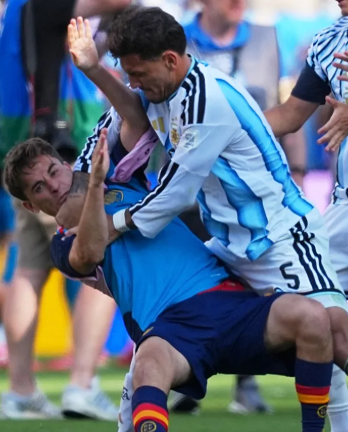
Updated: July 21, 2026 | Spain beat Argentina 1-0 in the World Cup Final. Then all hell broke loose. Punches were thrown. A petition broke every record in history. And now FIFA’s investigation could have consequences that reach all the way to the 2030 World Cup. Here is everything you need to know.
The 2026 FIFA World Cup Final should have ended in joy. Spain lifted the trophy. Their fans exploded. Rodri, Gavi, Pedri — the golden generation of Spanish football collected medals and wept with happiness.
But within seconds of the final whistle at MetLife Stadium in New Jersey on July 19, 2026, the occasion was overtaken by something uglier and more extraordinary — a brawl, a petition that nearly shattered a Guinness World Record, and a FIFA investigation that could reshape international football for the next decade.
Here is the full story — from the final whistle to the 23 million signatures. And the critical question nobody is yet answering properly: what does this mean for Argentina’s future in football?
1. What Happened at the 2026 World Cup Final?
- Date: Saturday, July 19, 2026
- Venue: MetLife Stadium, East Rutherford, New Jersey, USA
- Result: Spain 1–0 Argentina (after extra time)
- Celebrity attendees: Tom Cruise, David and Victoria Beckham, Javier Bardem, Sofía Vergara, Matt Damon, Shakira (who performed at the ceremony in a custom Roberto Cavalli gown featuring 200,000 Swarovski crystals), BTS, Madonna, Justin Bieber
- Spain won their second FIFA World Cup title — 16 years after their first in 2010
- Argentina entered the final as defending World Cup champions, having won in Qatar in 2022
- Tensions between the two squads had been building throughout the tournament — exacerbated by multiple controversies involving Argentina
- The match itself was extraordinarily tense — goalless through 90 minutes, with the winning goal arriving in extra time
- The moment the final whistle blew, Argentina players and staff did not walk away in defeat. They walked toward Spain’s celebrations.
2. The Brawl: What Actually Happened at Full Time — Every Detail
Spain’s bench of substitutes emptied onto the pitch to celebrate their historic victory, only to find themselves embroiled in a brawl with their Argentinian counterparts. Here is exactly what the footage and match reports confirm:
- Argentina right back Nahuel Molina appeared to strike Spain captain Rodri in the stomach as he ran past to join his celebrating teammates
- Molina then crowded Rodri, who was also subjected to a heated verbal confrontation by his former Manchester City teammate Nicolas Otamendi
- Leandro Paredes appeared to grab Spain’s Eric García by the throat, then followed up with what looked like a lunge at the prone Spanish midfielder
- Thiago Almada was involved in pushing and shoving with multiple Spanish players
- Argentina assistant coach Roberto Ayala was reported by Sky Sports to have swung at Spain midfielder Dani Olmo
- Enzo Fernandez — who had already been sent off during normal time for two bookable offences — became involved in post-match confrontations despite having no official standing on the pitch
- Argentina head coach Lionel Scaloni rushed onto the pitch and physically intervened to break up the confrontation
- The scenes lasted approximately 90 seconds before order was restored — but every second was captured on camera from multiple angles and broadcast to approximately 1.5 billion viewers worldwide
The specific players named in official reports and video evidence:
| Player | Action | Card During Match |
|---|---|---|
| Nahuel Molina | Appeared to strike Rodri in the stomach | No card given |
| Leandro Paredes | Grabbed Eric García by the throat; lunged at him | Red card after whistle |
| Nicolas Otamendi | Verbal confrontation with Rodri | Yellow card |
| Thiago Almada | Pushing and shoving with Spanish players | Yellow card |
| Enzo Fernandez | Involved in post-match confrontations | Red card during match |
| Roberto Ayala (assistant coach) | Appeared to swing at Dani Olmo | N/A — coaching staff |
3. This Was Not the Only Controversy — Argentina’s Full 2026 World Cup Scandal Timeline
The final brawl was the most dramatic moment — but it was the culmination of weeks of controversy surrounding Argentina at this tournament.
The Racist Chant History
Argentina have a documented and troubling history of discriminatory behaviour at international tournaments. In 2024, following their Copa America victory, Enzo Fernandez filmed teammates on the team bus singing a racist song targeting France’s players — including homophobic insults directed at Kylian Mbappé. FIFA opened an investigation. The French Football Federation filed a formal complaint. The songs themselves dated back to chants first sung during the 2022 World Cup Final in Qatar. Chelsea Football Club ultimately imposed a 10-match ban on Fernandez as a result. The pattern of discriminatory behaviour at Argentina’s tournament celebrations had already been firmly established before the 2026 World Cup began.
The Las Malvinas Banner — Semi-Final vs England (2026)
Following Argentina’s semi-final victory over England at the 2026 World Cup, several Argentina players celebrated by waving a banner reading “Las Malvinas son Argentinas” — meaning “The Falkland Islands are Argentine.” The Falkland Islands are a disputed territory between Argentina and the United Kingdom, and the banner constituted a deeply provocative political statement on the world’s biggest sporting stage. The UK government — through Downing Street — called publicly for a FIFA investigation into Argentina’s celebrations. The Argentine Football Association had been fined £20,000 by FIFA for displaying the exact same banner at the 2014 World Cup in Brazil. A repeat fine, expected to be substantially larger given the repeat offence, is widely anticipated.
The Egypt Quarter-Final Controversy
Throughout the tournament, accusations that refereeing decisions had systematically favoured Argentina — particularly in the quarter-final against Egypt — gained significant traction. Even respected football analysts began questioning the consistency of officiating in Argentina’s matches. Combined with the wider Trump-FIFA political backdrop and the perception of institutional favouritism, public trust in the tournament’s integrity had reached a low point before the final had even kicked off.
The Trump-FIFA Connection
The broader context of the 2026 World Cup included a well-documented relationship between FIFA president Gianni Infantino and US President Donald Trump, the host nation’s most powerful political figure. A controversial incident during the tournament in which a red card appeared to be retracted following political pressure added further fuel to the perception that officiating decisions were being influenced by factors beyond the game itself.
4. The Petition: 23 Million Signatures and a Near-Guinness World Record
This is the number that stopped the world.
A petition titled simply “Argentina Out” — hosted at argentinaout.com — was launched days before the World Cup Final and called for Argentina to be permanently expelled from the FIFA World Cup tournament.
Its description accused FIFA and referees of being “partially in favour of Lionel Messi and Argentina” and stated: “Why should the rest of the world compete if the winner is already decided? Kick Argentina out of the World Cup and give the rest a fair chance.”
The petition’s growth was extraordinary:
| Timeline | Signatures |
|---|---|
| Day 1 | 1 million |
| Day 3 | 10 million |
| Day 5 | 20 million |
| Final count | 23,316,108 |
| Guinness World Record | 24,319,181 |
| Countries represented | 170 |
The petition fell just 1,002,073 signatures short of the Guinness World Record for the largest petition ever — a record held by the Jubilee 2000 movement from 1997, which sought cancellation of unpayable debts of the world’s poorest countries before the year 2000.
The petition’s closing statement read: “More than 23 million people from 170 countries signed this petition in less than a week. FIFA ignored us. But Spain delivered. Thank you, Spain.”
The petition has now been closed.
5. FIFA’s Investigation: What Is Actually Being Investigated
FIFA confirmed the formal investigation in an official statement:
“Following an assessment of the relevant match reports for the FIFA World Cup final between Spain and Argentina, and in line with article 36 of the FIFA Disciplinary Code (FDC), the FIFA Disciplinary Committee has appointed a Disciplinary and Ethics Prosecutor to investigate potential breaches of the FDC with regard to the post-match incidents.”
Key facts about the investigation:
- The Disciplinary and Ethics Prosecutor has wide-ranging powers — they can investigate any offence under FIFA’s Disciplinary Code, not just violent conduct observed during the match
- Under the FDC, actions can be considered a violation of “basic rules of decent conduct” and “behaviour that brings the game into disrepute and/or FIFA into disrepute”
- The FDC provides for a ban of at least three matches for violent conduct, “or an appropriate period of time” — with additional disciplinary measures possible
- Players can be sanctioned retrospectively if video evidence reveals misconduct that went unpunished during or after the game — meaning Molina faces potential punishment despite receiving no card from the referee
- The investigation covers multiple separate incidents: the post-match brawl at the 2026 final, the Las Malvinas banner after the 2026 semi-final, and the cumulative pattern of discriminatory behaviour since 2022
- FIFA gave no timetable for completing the investigation
6. The Punishments Being Discussed: From Player Bans to Argentina’s World Cup Future
Here is every possible consequence, ranked from most certain to most extreme:
Certain — Automatic One-Match Bans
Leandro Paredes and Enzo Fernandez both received red cards and will each serve automatic one-match bans, to be applied in Argentina’s next competitive fixture. This is already confirmed regardless of the ongoing investigation.
Very Likely — Extended Bans for Paredes and Molina
The Disciplinary and Ethics Prosecutor is widely expected to extend Paredes’ ban beyond the automatic one match, given that his actions — grabbing a player by the throat and lunging at him — represent serious violent conduct. Nahuel Molina, who was not carded on the pitch but appeared to strike Rodri, faces retrospective punishment based on video evidence. Roberto Ayala, the assistant coach, could also face a touchline ban.
Likely — Argentine Football Association Fine
The AFA faces disciplinary action for the collective misconduct of its players and staff across the tournament. The Las Malvinas banner represents a repeat offence from 2014, meaning a fine significantly larger than the previous £20,000 is expected. The post-final brawl adds a further layer of institutional liability.
Possible — Forced Matches Behind Closed Doors
FIFA’s disciplinary code allows for a requirement that teams play matches without spectators present. Given the severity and repetition of Argentina’s misconduct, this is a genuine possibility for early qualifying matches for the 2030 World Cup.
The Realistic Worst Case — The 2030 World Cup Problem
The 2030 FIFA World Cup is co-hosted by Morocco, Portugal, Spain, Argentina, Uruguay and Paraguay — with Argentina hosting matches as part of the centenary celebration of the first-ever World Cup in 1930.
The question the football world has not yet answered is this: can FIFA exclude Argentina from the 2030 World Cup when Argentina is itself a co-host nation?
Technically, FIFA’s Disciplinary Code has no exemption for host nations. But in reality, excluding Argentina from a tournament they are co-hosting would require FIFA to break international agreements, repay billions in infrastructure investment, and navigate a political and legal battle of historic proportions.
The realistic consequences for the 2030 World Cup are:
- Argentina is required to qualify normally and serves player suspensions during qualifying
- Argentina is forced to play its 2030 group-stage home matches behind closed doors as a suspended-punishment condition
- The AFA pays a multi-million dollar fine and agrees to an enhanced conduct programme as a condition of participating
An outright exclusion from the 2030 World Cup remains the most extreme outcome. It has happened to other nations for football-specific governance violations — but never to a co-host of a major tournament. FIFA would face an extraordinary legal and political battle to make it happen.
7. The Messi Question
Lionel Messi — widely regarded as the greatest footballer of all time — did not appear to be directly involved in the post-match brawl. He was on the pitch. He is the captain. He is the face of Argentine football.
The petition that gathered 23 million signatures cited Messi by name as a reason for Argentina’s perceived preferential treatment. The question of whether Messi’s extraordinary individual legacy is being damaged by the behaviour of his teammates and coaching staff — in what may be his final World Cup appearance at 38 years old — is one that football fans and analysts are already debating with intensity.
Messi has not publicly addressed the post-match incidents. That silence has itself become part of the story.
8. Argentina’s Response — What They Said and Did Not Say
Argentina’s response to the post-match controversy has been notable primarily for what has not been said:
- The Argentine Football Association has not issued a formal apology for the post-match behaviour
- Lionel Messi has not commented publicly on the brawl or the Las Malvinas banner
- Leandro Paredes posted on social media hours after the match without referencing the incidents
- Nahuel Molina also posted publicly without acknowledging the specific moment involving Rodri
- Coach Lionel Scaloni, who physically intervened to stop the fighting, spoke briefly in his post-match press conference about the result but gave no substantive response to questions about the brawl
The absence of any meaningful acknowledgment from Argentina’s players, coach or federation has intensified the anger of the 23 million petition signatories — and made it significantly harder for FIFA to accept a quiet resolution.
9. The Pattern of Behaviour: A Full Record
For those following Argentina’s international conduct closely, the 2026 World Cup Final was not a surprise. It was a pattern reaching its most visible conclusion:
| Tournament | Incident | FIFA Action |
|---|---|---|
| World Cup 2022 (Qatar) | Post-match songs with fascist connotations vs Morocco | Investigated |
| Copa America 2024 | Racist chants targeting France players — Fernandez video | Fernandez banned 10 matches by Chelsea; FIFA fine |
| World Cup 2026 | Las Malvinas banner after beating England in semi-final | Under investigation |
| World Cup 2026 | Post-final brawl with Spain players and coaching staff | Under investigation |
The cumulative record now represents something FIFA cannot simply fine its way past. The governing body faces a genuine credibility test — whether it will take meaningful action against one of football’s most commercially valuable national teams, or issue another fine and allow the pattern to continue.
Key Facts Overview
| Attribute | Detail |
|---|---|
| World Cup Final Date | July 19, 2026 |
| Venue | MetLife Stadium, New Jersey, USA |
| Result | Spain 1–0 Argentina (after extra time) |
| Brawl Trigger | Nahuel Molina appeared to strike Rodri at full time |
| Players Involved | Molina, Paredes, Otamendi, Almada, Fernandez |
| Staff Involved | Roberto Ayala (assistant coach) |
| FIFA Statement | Disciplinary and Ethics Prosecutor appointed |
| Petition Name | Argentina Out (argentinaout.com) |
| Petition Signatures | 23,316,108 |
| Countries Signed | 170 |
| Guinness Record (existing) | 24,319,181 — not broken |
| Signatures Short of Record | 1,002,073 |
| Las Malvinas Banner | Displayed after semi-final win over England |
| 2030 World Cup | Argentina is co-host — complicates any exclusion |
| Automatic Bans | Paredes and Fernandez — one match each |
Frequently Asked Questions
Q1: What happened at the end of the 2026 World Cup Final? A: Following Spain’s 1-0 victory over Argentina in extra time at MetLife Stadium on July 19, 2026, a brawl broke out between players from both sides. Argentina’s Nahuel Molina appeared to strike Spain captain Rodri, Leandro Paredes appeared to grab Eric García by the throat, and Argentina assistant coach Roberto Ayala was reported to have swung at Spain midfielder Dani Olmo. FIFA subsequently launched a formal disciplinary investigation.
Q2: How many people signed the Argentina Out petition? A: The petition titled “Argentina Out” gathered 23,316,108 signatures from 170 countries. This fell just over one million short of the Guinness World Record for the largest petition in history, which stands at 24,319,181 signatures — held by the Jubilee 2000 movement from 1997. The petition has since been closed.
Q3: Will Argentina be banned from the next World Cup? A: An outright ban is the most extreme possible outcome and is historically unprecedented for a co-host nation. Argentina is a co-host of the 2030 World Cup, which significantly complicates any exclusion scenario. More likely consequences include extended bans for individual players such as Molina and Paredes, substantial fines for the Argentine Football Association, and potentially forced matches behind closed doors in early 2030 qualifying.
Q4: What punishment does Leandro Paredes face? A: Paredes received a red card after the final whistle and faces an automatic minimum one-match ban. FIFA’s investigation may extend that ban significantly if the Disciplinary and Ethics Prosecutor determines his actions — grabbing Eric García by the throat and lunging at him — constitute serious violent conduct warranting a longer suspension.
Q5: What was the Las Malvinas controversy? A: Following Argentina’s semi-final victory over England, several Argentina players displayed a banner reading “Las Malvinas son Argentinas” — claiming sovereignty over the Falkland Islands, a territory disputed between Argentina and the United Kingdom. The UK government called for a FIFA investigation. Argentina was previously fined £20,000 for the same offence at the 2014 World Cup. A repeat and substantially larger fine is widely expected.
Q6: Is Lionel Messi being punished? A: Messi has not been directly accused of involvement in the post-match brawl. However, as team captain, he carries collective responsibility for his team’s conduct, and his silence on the incidents has intensified criticism. FIFA’s investigation covers team and coaching staff behaviour as well as individual players.
Q7: What is the Guinness World Record for the largest petition? A: The current Guinness World Record is 24,319,181 signatures, held by the Jubilee 2000 movement from 1997, which called for cancellation of unpayable debts of the world’s poorest countries before the year 2000. The Argentina Out petition fell just over one million signatures short of breaking it.
Q8: How could this affect Argentina at the 2030 World Cup? A: Argentina is a co-host of the 2030 World Cup, making outright exclusion extraordinarily complex. Legally, FIFA’s Disciplinary Code does not exempt co-hosts from punishment. Realistically, the most likely impacts are individual player suspensions applied during 2030 qualifying, potential forced matches behind closed doors, and significant AFA fines imposed as conditions of participation.
Q9: Who started the brawl at the World Cup Final? A: Video evidence and official match reports indicate the confrontation was triggered by Argentina right back Nahuel Molina, who appeared to strike Spain captain Rodri in the stomach as Rodri ran to celebrate the final whistle. The situation then escalated rapidly, involving multiple Argentina players and at least one member of Argentina’s coaching staff.
Sources: Euronews, Yahoo Sports, Sports Illustrated, ABC7 Los Angeles, TNT Sports, Hola US, Al Jazeera, AP, BBC Sport, Sky Sports, The Independent