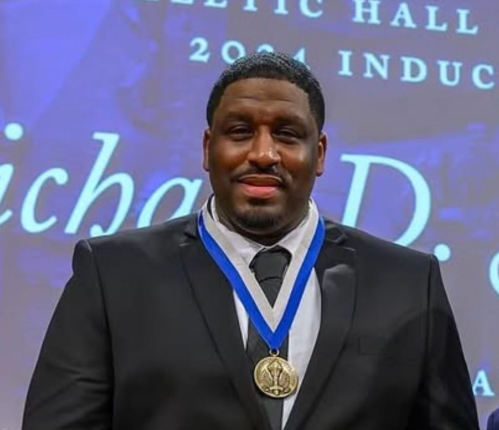
The Heartbreaking News: Former Georgetown Phenom and Knicks Lottery Pick Dies at 43
The basketball world and the broader sports community were plunged into deep mourning when news broke that former Georgetown University All-American power forward and New York Knicks lottery pick Michael “Mike” Sweetney passed away on Wednesday, September 17, 2026, at Newark Beth Israel Medical Center in New Jersey. He was just 43 years old. His sudden death resulted from medical complications following a severe heart attack, bringing a tragic and premature end to a life marked by staggering collegiate athletic dominance, professional resilience, courage in mental health advocacy, and transformative youth coaching.
His devoted wife of nearly two decades, India Sweetney, shared the devastating news in an emotional statement on social media, expressing the immense loss felt by their family and everyone who was touched by his gentle, generous spirit:
“With the heaviest hearts, we are deeply saddened to announce the passing of our beloved Michael. To know Mike Sweetney was to love him. No one loved him more and he loved no one more than his family. His children were the light of his life, and he lived every day to give them the best life possible. He’s been my best friend for 30 years and my husband for almost 20. I’m not sure what we or I will do without him.”
As news of Sweetney’s death spread across the nation, official tributes poured in from the institutions and teams that defined his basketball journey. The New York Knicks, who selected Sweetney with the ninth overall pick in the iconic 2003 NBA Draft, issued an official statement honoring his memory:
“The Knicks are saddened to hear about the passing of Michael Sweetney. Michael was an incredible person who will be missed by many. Our thoughts and prayers are with his family and loved ones during this difficult time.”
The Chicago Bulls, where Sweetney spent two seasons from 2005 to 2007, also expressed their grief:
“Our Bulls family extends our heartfelt condolences to the family and friends of former Bull Michael Sweetney, who has passed away at 43. Mike was a warm, dedicated teammate whose presence left a lasting impression on everyone in our organization.”
Beyond his professional NBA career, Sweetney built a profound second legacy in New York and New Jersey as a beloved mentor and basketball coach within the Orthodox Jewish sports community. Serving as an assistant coach at Yeshiva University during their legendary 50-game winning streak and coaching at local Jewish day schools like Ramaz and Golda Och Academy, Sweetney earned the deep affection of players, parents, and fellow coaches who remembered him as a true ally and a humble giant who always showed up when people needed him most.
Mike Sweetney Quick Wiki-Style Statistics Table
To honor the life and career of Michael Damien Sweetney, let us review his verified personal, physical, academic, and professional statistics in this comprehensive profile grid:
| Personal & Career Metric | Verified Details & Profile Statistics |
|---|---|
| Full Birth Name | Michael Damien Sweetney |
| Nickname | Mike Sweetney, “Sweet” |
| Date of Birth (DOB) | October 25, 1982 |
| Date of Passing | September 17, 2026 (Aged 43) |
| Place of Birth | Washington, D.C., United States |
| Place of Passing | Newark, New Jersey (Newark Beth Israel Medical Center) |
| Cause of Death | Complications following a heart attack |
| Barefoot Height | 6 Feet 8 Inches (203 cm) |
| Listed Playing Weight | 270 lbs (122 kg) (Fluctuated between 260–300+ lbs) |
| Body Frame / Build | Broad-Shouldered, Heavyweight Power Frame |
| Eye Color | Dark Brown |
| Hair Color | Black / Dark Brown |
| High School | Oxon Hill High School (Oxon Hill, Maryland) |
| High School Honors | Washington Post All-Met Basketball Player of the Year |
| College | Georgetown University (2000–2003) |
| College Stats (Junior Year) | 22.8 PPG, 10.4 RPG, 3.2 BPG, 54.7% FG |
| College Accolades | NABC 2nd-Team All-American (2003), Sporting News 3rd-Team All-American |
| NBA Draft | 2003 NBA Draft / Round 1 / 9th Overall Pick (New York Knicks) |
| NBA Positions | Power Forward / Center |
| NBA Jersey Numbers | #50 (New York Knicks), #60 (Chicago Bulls) |
| NBA Teams Played For | New York Knicks (2003–2005), Chicago Bulls (2005–2007) |
| NBA Career Totals | 233 Games, 73 Starts, 6.5 PPG, 4.5 RPG, 48.5% FG |
| International Leagues | China, D-League, Puerto Rico, Dominican Republic, Uruguay, Venezuela, BIG3 |
| Coaching Career | Yeshiva University (Assistant, 2019–2023), Ramaz School, Golda Och Academy |
| Wife / Spouse | India Sweetney (Married 2007; Together 30 years) |
| Children | 3 Children |
| NBA Career Contract Earnings | Approximately $11.5 Million USD (Pre-tax) |
| Estimated Net Worth (2026) | $1.5 Million to $3.0 Million USD |
Early Life in Washington D.C. and Oxon Hill High School Stardom
Michael Damien Sweetney was born on October 25, 1982, in Washington, D.C., growing up in the surrounding Prince George’s County suburb of Oxon Hill, Maryland. Raised in a close-knit, supportive household, young Mike discovered his passion for basketball at an early age. Blessed with natural height, broad shoulders, and uncommonly soft hands, he quickly stood out among his peers in the competitive District-Maryland-Virginia (DMV) basketball circuit.
Enrolling at Oxon Hill High School, Sweetney developed under high school coaches who recognized that his physical size was paired with rare footwork and exceptional basketball instincts. Rather than relying solely on brute force, Sweetney mastered the fundamentals of low-post play. He honed a soft drop-step, a precise hook shot off either shoulder, and an uncanny ability to carve out interior positioning on the rebounds.
By his senior year at Oxon Hill, Sweetney was widely regarded as one of the most imposing high school frontcourt prospects in the entire nation. He dominated local competition, leading Oxon Hill to regional tournament runs while averaging monster double-doubles. His stellar high school performance earned him the prestigious title of Washington Post All-Met Basketball Player of the Year, placing his name alongside former DMV high school legends.
Major college recruiters from across the country flocked to Maryland to court the 6-foot-8 power forward. Sweetney received scholarship offers from elite ACC and Big East programs. However, when it came time to make his college decision, Sweetney chose to stay close to home and commit to one of the most storied big-man pipelines in college basketball history: the Georgetown Hoyas.
The Georgetown Hoyas Dynasty: Becoming a College All-American
When Mike Sweetney arrived on the campus of Georgetown University in Washington, D.C., in the fall of 2000, he stepped directly into a basketball program world-famous for producing dominant interior big men. Following in the historical footsteps of Hall of Fame centers like Patrick Ewing, Alonzo Mourning, and Dikembe Mutombo, Sweetney embraced the challenge of carrying the Hoyas’ frontcourt tradition under head coach Craig Esherick.
From his very first collegiate game as a freshman during the 2000–2001 NCAA season, Sweetney proved that his low-post skills translated seamlessly to the physical Big East Conference. Starting all 33 games as a true freshman, he averaged 12.8 points, 7.4 rebounds, and 0.7 blocks per game while shooting an efficient 51.6% from the field. His poise under the glass helped lead Georgetown to a 23-8 record and a trip to the NCAA Sweet Sixteen.
As a sophomore during the 2001–2002 campaign, Sweetney took a massive leap forward into national stardom. Establishing himself as an unstoppable interior force, he raised his averages to 19.0 points, 10.0 rebounds, and 1.7 blocks per game in 29 contests. Opposing Big East defenses routinely double-teamed and triple-teamed him in the paint, yet Sweetney’s footwork and soft touch allowed him to shoot 56.7% from the floor while drawing fouls at one of the highest rates in college basketball.
However, it was his junior season in 2002–2003 that etched Mike Sweetney’s name permanently into Georgetown basketball lore. Playing with relentless energy and absolute interior dominance, Sweetney delivered one of the most statistically impressive single-season campaigns in Big East history. In 34 games, he averaged an incredible 22.8 points, 10.4 rebounds, and 3.2 blocks per game, while shooting 54.7% from the field and 73.8% from the free-throw line.
Sweetney was not just scoring points; he was single-handedly anchoring the Hoyas on both ends of the floor. He became the only player in Georgetown history to record at least 700 points and 300 rebounds in a single season. His memorable performances included a 38-point, 15-rebound masterpiece against Notre Dame and multiple 30-plus point outings against conference rivals.
For his extraordinary junior campaign, Sweetney was named a Consensus Second-Team All-American by the NABC and a Third-Team All-American by The Sporting News. He was selected as a finalist for both the Naismith College Player of the Year and the John R. Wooden Award. Having accomplished everything possible at the collegiate level and solidified his standing as an elite pro prospect, Sweetney announced in the spring of 2003 that he would forgo his senior season and enter the NBA Draft.
The Legendary 2003 NBA Draft & Joining the New York Knicks
The 2003 NBA Draft is universally celebrated by basketball historians as one of the single greatest draft classes in sports history, featuring future Hall of Famers like LeBron James, Carmelo Anthony, Chris Bosh, and Dwyane Wade. On June 26, 2003, inside the Theatre at Madison Square Garden, the New York Knicks selected Mike Sweetney with the ninth overall pick in the first round.
For a 20-year-old power forward from Maryland, being drafted by the Knicks meant stepping into the brightest media spotlight in professional sports. The Knicks front office and fan base envisioned Sweetney as a new physical anchor for their frontcourt, hoping his rebounding and post scoring could revitalize the franchise in the post-Patrick Ewing era.
Sweetney made his NBA debut during the 2003–2004 season under head coach Don Chaney and later Lenny Wilkens. Joining a veteran roster that featured point guard Stephon Marbury, shooting guard Allan Houston, and forward Antonio McDyess, Sweetney spent his rookie season adapting to the speed and physical rigor of the professional game. Appearing in 42 games (1 start), he averaged 7.0 points and 4.8 rebounds in 16.8 minutes per game, showing promising efficiency with a 52.2% field goal percentage.
In his sophomore season (2004–2005), Sweetney earned an expanded role in the Knicks’ rotation, appearing in 77 games and starting 28 contests. Playing alongside guard Jamal Crawford and center Nazr Mohammed, Sweetney put his scoring touch and offensive rebounding prowess on full display. He posted career-high averages of 8.4 points and 5.4 rebounds in 19.6 minutes per game, while shooting 53.1% from the field.
On numerous occasions, Sweetney recorded impressive double-doubles, demonstrating that when given consistent playing time, his footwork and positioning made him a formidable low-post scorer against NBA competition. However, behind the scenes in New York, complex personal struggles and mounting pressure regarding his physical weight were beginning to take a heavy toll on the young forward.
Trade to the Chicago Bulls and Fighting Weight Struggles
In October 2005, prior to the start of the 2005–2006 NBA season, the New York Knicks executed a blockbuster multi-player trade with the Chicago Bulls. In a deal centered around centers Eddy Curry and Antonio Davis, the Knicks included Mike Sweetney, Tim Thomas, and Jermaine Jackson, sending them to Chicago in exchange for draft compensation and veteran frontcourt help.
Joining a young, energetic Chicago Bulls squad coached by Scott Skiles and featuring star guards Ben Gordon, Kirk Hinrich, Luol Deng, and rookie forward Andrés Nocioni, Sweetney was thrust into a primary starting role. During the 2005–2006 season, Sweetney appeared in 66 games for Chicago, starting 44 contests at power forward and center. He averaged 8.1 points and 5.3 rebounds in 18.5 minutes per game, helping the Bulls secure a playoff berth in the Eastern Conference.
Despite his productivity on the floor, Sweetney faced persistent scrutiny from coaches, executives, and sports media over his physical conditioning. Listed at 6-foot-8 and 270 pounds, Sweetney’s weight began to climb toward 300 pounds as he battled severe internal stress and emotional eating. The relentless media commentary surrounding his body shape created a painful feedback loop, making it increasingly difficult for him to maintain peak NBA conditioning.
During the 2006–2007 season, his role in Chicago diminished as the Bulls acquired veteran defensive center Ben Wallace and developed younger frontcourt talent like Tyrus Thomas. Sweetney appeared in 48 games (0 starts), averaging 3.2 points and 2.5 rebounds in 8.0 minutes per contest. At the conclusion of the 2006–2007 season, Sweetney’s initial rookie contract expired, and at age 24, his four-year NBA stint came to an end after 233 regular-season games and 11 playoff appearances.
The International Career: A Global Basketball Odyssey
Although his NBA chapter ended in 2007, Mike Sweetney’s passion for the game of basketball remained undiminished. Refusing to let external criticism define his athletic journey, Sweetney spent the next decade embarking on a globe-trotting professional playing career that spanned four continents.
In 2009, Sweetney signed with the Boston Celtics for training camp, showing impressive post scoring before being waived prior to the regular season. He then took his talents overseas, playing for the Shaanxi Kylins in the Chinese Basketball Association (CBA), where he averaged over 20 points and 10 rebounds per game. He returned to the United States in 2010 for a stint with the Erie BayHawks in the NBA Development League (now G League).
Sweetney found a welcoming home in Latin American basketball leagues, where his veteran savvy, physical screen-setting, and touch around the rim made him a beloved fan favorite. He starred in Puerto Rico’s Baloncesto Superior Nacional (BSN) for major clubs including Cangrejeros de Santurce, Vaqueros de Bayamón, and Brujos de Guayama. He also played professionally in the Dominican Republic with Metros de Santiago, in Venezuela with Guaiqueríes de Margarita, and in Uruguay with Club Biguá, Club Atlético Atenas, and Urunday Universitario.
Even in his mid-30s, Sweetney continued playing competitive basketball, participating in Ice Cube’s 3-on-3 BIG3 league alongside former NBA peers. His decade-long post-NBA playing odyssey demonstrated his profound love for the sport and his determination to stay connected to the hardwood.
Breaking the Stigma: Courageous Mental Health and Suicide Prevention Advocacy
While Mike Sweetney’s basketball journey was filled with highlight-reel moments, his most courageous and impactful work occurred off the court. In 2017, during an extraordinarily candid interview with HoopsHype, Sweetney publicly revealed the severe mental health struggles he had suffered in secret during his NBA playing days.
Sweetney revealed that during his rookie season with the New York Knicks in 2003—shortly after the sudden death of his beloved father—he descended into a dark, suffocating depression. Overwhelmed by grief, homesickness, media scrutiny, and the crushing pressure of being a high NBA draft pick, Sweetney attempted suicide in a hotel room during a Knicks road trip.
“I was suffering from severe depression, and nobody knew,” Sweetney revealed in 2017. “I was crying myself to sleep at night. I attempted suicide when I was in New York. I took a bunch of pain pills, hoping it would end everything… I survived, but I kept that secret buried inside me for years because back then, nobody in professional sports talked about mental health. You were expected to just be tough and ignore it.”
After receiving professional medical help, therapy, and strong emotional support from his family, Sweetney gradually learned to manage his depression. Once he stepped away from professional playing, he made a conscious decision to transform his painful personal experience into a platform to save young lives.
Sweetney became a passionate national advocate for mental health awareness and suicide prevention. He traveled across the country visiting high schools, middle schools, community centers, and youth sports camps, speaking openly to teenagers about depression, body image, and emotional trauma. He encouraged young people to break their silence and seek professional help at the earliest signs of emotional distress:
“I tell these kids, ‘Look at me. I played in the NBA, I was a lottery pick, and I still went through the darkest room imaginable. You are never alone, and asking for help is not a sign of weakness—it is the ultimate sign of strength.'”
Through his public speaking and foundation work, Sweetney helped dismantle the toxic stigma surrounding mental health in sports years before active NBA stars began speaking publicly about the topic.
A Beloved Mentor in the Orthodox Jewish Hoops Community
One of the most extraordinary and heartwarming chapters of Mike Sweetney’s life was his deep, enduring connection to the Orthodox Jewish basketball community in New York and New Jersey—a unique partnership that spanned more than a quarter of a century.
The origin of this unlikely friendship dates back to the year 2000, when Sweetney was a senior at Oxon Hill High School attending an All-Star showcase practice in the DMV area. At the practice was Tamir Goodman, a redheaded, yarmulke-wearing Orthodox Jewish high school prodigy nicknamed “The Jewish Jordan.” While other players kept their distance from Goodman, the 6-foot-8 Georgetown-bound Sweetney walked over with a warm smile and asked Goodman to be his shooting partner.
From that single gesture of warmth, a lifelong brotherhood was born. Sweetney later recalled that he had never met a Jewish person before that day, but the two players formed an instantaneous bond. Years later, after Sweetney retired from professional play and settled in the Tri-State area, he reconnected with Goodman and the broader Jewish basketball network.
In 2019, Yeshiva University head basketball coach Elliot Steinmetz hired Sweetney as an assistant coach for the Maccabees men’s team in New York City. Sweetney brought immense credibility, gentle guidance, and high-level post coaching to the NCAA Division III program. During his four seasons on the coaching staff from 2019 to 2023, Sweetney helped guide Yeshiva University through a historic 50-game winning streak that captured international sports headlines and propelled the Maccabees to a No. 1 national ranking in Division III.
Sweetney did not limit his coaching to the collegiate level. He served as the head coach for the girls varsity basketball team at the Ramaz School in Manhattan and worked at local youth camps, synagogues, and basketball clinics. On August 18, 2026, Golda Och Academy—a Jewish day school in West Orange, New Jersey—announced the high-profile hiring of Sweetney as their head coach for the 2026–2027 boys varsity basketball team.
When Sweetney passed away, Jewish leaders, players, and families across New York and New Jersey paid emotional tribute to a man who had become family to their community. Yeshiva head coach Elliot Steinmetz wrote on X:
“The world lost a giant today. I lost a close friend. The basketball world lost a beloved star. Our Jewish community lost an ally and someone who knew exactly how to show up. Mike Sweetney wasn’t just a friend. He was family. When you needed him, he was there. Always. You didn’t even have to ask.”
David Kibbe Physical Frame & Athletic Conditioning Analysis
In evaluating Mike Sweetney’s physical presence through structural body analysis frameworks such as the David Kibbe typology, Sweetney’s frame aligns clearly with the Dramatic / Flamboyant Natural category adapted for professional heavyweight athletes:
- Skeletal Structure & Bone Density: Standing at a barefoot height of 6 feet 8 inches (203 cm) with a massive 7-foot+ wingspan, Sweetney possessed exceptional skeletal width, broad collarbones, and heavy bone density. His low center of gravity made him virtually unmovable in the post.
- Muscular Volume & Power Output: In his collegiate prime at Georgetown, Sweetney combined explosive vertical lift with dense muscle mass, allowing him to absorb heavy contact while finishing contested layups and blocking shots.
- Conditioning Challenges & Weight Fluctuation: Throughout his professional career, Sweetney’s weight fluctuated between 260 lbs and over 300 lbs. Because his body frame naturally stored mass quickly during periods of stress, maintaining low body fat required extreme, continuous cardio conditioning.
Personal Life, Family, Marriage to India, and Net Worth Analysis
Beyond the noise of the basketball arenas, Mike Sweetney’s true sanctuary was his family. Sweetney met his wife, India Sweetney, during his high school years in Maryland. Their bond spanned over 30 years, and they were married for nearly two decades. Together, they raised three children, who Mike repeatedly described as the light of his life.
Financially, Sweetney earned approximately $11.5 Million USD in gross player salary during his four seasons in the NBA with the New York Knicks and Chicago Bulls, plus additional earnings from international playing contracts in China, Puerto Rico, and South America. At the time of his passing in September 2026, his estimated net worth was valued between $1.5 Million and $3.0 Million USD. He lived a modest, peaceful family life in New Jersey, focusing his financial resources on providing a secure upbringing for his children and funding youth basketball programs.
Tributes, Condolences, and Enduring Legacy
The legacy of Michael Damien Sweetney extends far beyond points, rebounds, and draft position. He was a man who experienced the highest heights of college basketball stardom and the dark depths of personal depression, emerging with a compassionate heart dedicated to uplifting others.
From Madison Square Garden and the United Center to the gymnasiums of Georgetown and Yeshiva University, Mike Sweetney will be remembered as a dominant power forward, a courageous mental health pioneer, a devoted husband and father, and a beloved mentor whose warmth brought communities together.
Frequently Asked Questions (FAQs)
1. When and how did Mike Sweetney pass away?
Mike Sweetney passed away on Wednesday, September 17, 2026, at Newark Beth Israel Medical Center in New Jersey at the age of 43 due to medical complications following a heart attack.
2. What were Mike Sweetney’s exact height and weight?
Mike Sweetney stood at a barefoot height of 6 feet 8 inches (203 cm) and had a listed NBA playing weight of 270 lbs (122 kg), though his weight fluctuated during his career.
3. Which NBA teams did Mike Sweetney play for?
Mike Sweetney was drafted 9th overall in the 2003 NBA Draft by the New York Knicks, playing two seasons in New York (2003–2005) before playing two seasons for the Chicago Bulls (2005–2007).
4. What was Mike Sweetney’s college career like at Georgetown?
Sweetney was an All-American star for the Georgetown Hoyas from 2000 to 2003. In his junior year (2002–03), he averaged 22.8 points, 10.4 rebounds, and 3.2 blocks per game, becoming a finalist for the Naismith and Wooden Awards.
5. Who is Mike Sweetney’s wife?
Mike Sweetney was married to India Sweetney. The couple were best friends for 30 years and married for nearly 20 years, raising three children together.
6. What was Mike Sweetney’s connection to Yeshiva University?
Sweetney served as an assistant coach for the Yeshiva University men’s basketball team from 2019 to 2023, helping lead the team during their historic 50-game winning streak in NCAA Division III.
7. How did Mike Sweetney advocate for mental health?
In 2017, Sweetney publicly revealed his past battle with severe depression and a suicide attempt during his rookie NBA season. He spent years traveling to schools and youth groups across America speaking about depression awareness and suicide prevention.
8. What was Mike Sweetney’s estimated net worth at the time of his passing?
At the time of his passing in September 2026, Mike Sweetney’s net worth was estimated at $1.5 Million to $3.0 Million USD, backed by $11.5 Million in career NBA contract earnings.
Tactical Breakdown of Mike Sweetney’s Low-Post Game & Rebounding Mechanics
To truly appreciate why Mike Sweetney was selected ninth overall in a draft filled with future Hall of Famers, one must analyze the tactical and technical mechanics that made his low-post game so devastating during his collegiate prime at Georgetown. Standing 6 feet 8 inches with a 270-pound frame, Sweetney possessed a unique combination of raw power, exceptional lower-body balance, and remarkably quick footwork that confounded opposing college centers and power forwards.
1. Sealing and Carving Out Interior Position
Long before the ball ever crossed half-court, Sweetney was working to establish deep interior position. Using his broad shoulders and wide base, he excel in “pinning” defenders under the rim. He had an innate understanding of leverage, using his hips to seal off his defender’s legs so that even taller 7-foot centers could not reach over him without committing a reach-in foul.
2. Drop-Step and Shoulder-Fake Mastery
Once Sweetney received the entry pass on the low block, his secondary move set was remarkably fluid. He operated with a rapid drop-step toward the baseline or an aggressive spin into the key. His signature move was a subtle head-and-shoulder fake that lifted shot-blockers off their feet, allowing him to absorb contact and finish with either hand or draw a trip to the free-throw line. During his junior season at Georgetown, Sweetney attempted an astounding 317 free throws in 34 games, converting nearly 74% of them—an elite rate for a heavy interior big man.
3. Offensive Rebounding Intuition and Second-Chance Conversion
One of Sweetney’s greatest statistical strengths was his offensive rebounding rate. He possessed a natural “feel” for the flight of the ball off the rim, anticipating ricochets before guards even released their shots. Rather than waiting for the ball to descend, Sweetney used his quick second jump to tip rebounds to himself or tip the ball directly into the basket. In the NBA, his offensive rebounding percentage remained at an elite level, allowing him to create immediate second-chance points in limited bench minutes.
The 2003 NBA Draft Class in Hindsight: Where Sweetney Fitted Among Legends
The 2003 NBA Draft remains arguably the most influential talent collection in modern professional basketball history. The top of the draft featured transcendent superstars who reshaped the league for two decades: LeBron James (1st overall), Carmelo Anthony (3rd overall), Chris Bosh (4th overall), and Dwyane Wade (5th overall).
When the New York Knicks selected Mike Sweetney with the ninth overall pick, they were selecting him ahead of several notable future NBA starters and All-Stars, including David West (18th overall), Boris Diaw (21st overall), Kendrick Perkins (27th overall), and Leandro Barbosa (28th overall).
At the time, Knicks President of Basketball Operations Scott Layden and head coach Don Chaney viewed Sweetney as a classic Big East frontcourt anchor who offered immediate interior scoring and physical rebounding. New York was in the midst of a difficult transition period following the Patrick Ewing era, and the front office was eager to rebuild an identity around toughness and painted-area scoring.
While Sweetney’s NBA career did not reach the All-Star heights of LeBron, Carmelo, Bosh, or Wade, his collegiate credentials at Georgetown were undeniably equal to any frontcourt prospect in that draft class. His 22.8 points and 10.4 rebounds per game during his junior season surpassed the college production of nearly every other big man selected in 2003. His abbreviated NBA career highlighted the tragic reality of how unaddressed mental health struggles, weight management hurdles, and organizational instability can impact even the most gifted young athletes.
Deep Dive: The Yeshiva University 50-Game Winning Streak & Sweetney’s Coaching Footprint
When Mike Sweetney joined head coach Elliot Steinmetz’s staff at Yeshiva University in Manhattan in 2019, the NCAA Division III program was on the cusp of an unprecedented national breakthrough. As a small, Orthodox Jewish institution, Yeshiva University faced unique scheduling constraints, balancing rigorous Torah study, academic coursework, and athletic competition.
Sweetney brought an immediate aura of professional authority and genuine warmth to the team’s practice gym at the Max Stern Athletic Center. Rather than behaving like a former NBA lottery pick above Division III competition, Sweetney immersed himself entirely in the development of the players. He spent hours after practice working one-on-one with Yeshiva’s frontcourt players, teaching them the exact footwork, pump-fakes, and positioning tactics he had mastered at Georgetown and in the NBA.
Under the guidance of Steinmetz and Sweetney, the Yeshiva Maccabees went on an astonishing 50-game winning streak that spanned from November 2019 to December 2021. The streak became a national sports sensation, covered by ESPN, The New York Times, Sports Illustrated, and major television networks. Yeshiva reached a No. 1 ranking in Division III national polls, and the team’s perimeter-passing, high-efficiency offense mesmerized basketball fans worldwide.
Players at Yeshiva frequently noted that Sweetney’s impact went far beyond tactical drills. He was a calming, reassuring presence on the bench during tight, high-pressure games. Having endured severe media pressure and personal mental health battles himself, Sweetney was uniquely equipped to mentor young student-athletes on how to stay grounded, manage anxiety, and keep the game in perspective.
Signature Game Archive: Legendary Performances of Mike Sweetney’s Career
To understand why Mike Sweetney was revered by teammates, opponent coaches, and fans, one must revisit the signature games where his interior skill, scoring efficiency, and relentless hustle took complete control of the floor.
1. Georgetown vs. Notre Dame (February 2003): The 38-Point Masterpiece
In one of the most remarkable individual performances in Big East Conference history, junior Mike Sweetney put on a clinic against Notre Dame. Facing a double-team on nearly every possession, Sweetney recorded 38 points and 15 rebounds, converting 14-of-20 field goals and going 10-of-11 from the free-throw line. His low-post fakes and drop-steps left the Irish frontcourt helpless, cementing his status as a consensus All-American.
2. Georgetown vs. Syracuse (January 2003): Dominating the Carrier Dome
In a heated Big East rivalry game inside the massive Carrier Dome, Sweetney battled Syracuse’s freshman phenom Carmelo Anthony and senior forward Hakim Warrick. Sweetney posted 31 points, 19 rebounds, and 5 blocks, anchoring the Hoyas in a double-overtime thriller. His ability to dominate the offensive glass against Syracuse’s 2-3 zone defense showcased his elite basketball IQ.
3. New York Knicks vs. Charlotte Bobcats (April 2005): A Career-High NBA Night
In his sophomore season with the Knicks, Sweetney earned a starting nod against Charlotte at Madison Square Garden. Playing 34 minutes, Sweetney recorded a career-high 24 points and 12 rebounds on 9-of-11 shooting from the field. The Garden crowd erupted in chants of “Sweet-ney!” as he outworked the Bobcats interior defense for putback dunks and second-chance buckets.
4. Chicago Bulls vs. Washington Wizards (April 2006): Powering Chicago to the Playoffs
During his first season with the Bulls, Sweetney delivered a clutch late-season performance against his hometown team, the Washington Wizards. Starting at center, Sweetney poured in 19 points and grabbed 13 rebounds in 26 minutes, leading Chicago to a crucial victory that secured their postseason seed.
The Legacy of Human Kindness: How Mike Sweetney Changed Lives Off the Court
When reflecting on the 43 years of Mike Sweetney’s life, his greatest victories were not recorded in box scores or draft boards. They were recorded in the lives of the young people he saved from suicide, the student-athletes he coached at Yeshiva, Ramaz, and Golda Och, and the warm friendships he cultivated across cultural lines.
In an era where celebrity culture often fosters distance and cynicism, Mike Sweetney chose vulnerability, empathy, and active presence. He proved that an individual’s true worth is measured not by how high they rise in professional sports, but by how gently and generously they lift others up along the way. His legacy as a devoted father, loving husband, courageous mental health advocate, and beloved basketball mentor will continue to inspire generations for years to come.